
Lakuntza
Where the rock opens out onto the valley

Where the rock opens out onto the valley
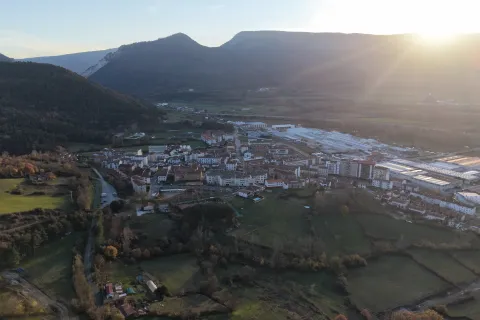
In this stretch of the valley, the River Arakil flows through the fertile plain whilst the Aralar and San Donato mountain ranges form a firm and silent horizon. Lakuntza spreads out across the plain amongst cobbled streets and open spaces where history still breathes. The mark of its origins as a bastide town is evident in the order of its urban layout, whilst daily life flows calmly amidst centuries-old walls. It is a place where ancient routes, living traditions and the tranquillity of the square forge an identity that is felt quite naturally.
Lakuntza is located in the north-west of Navarre, within the region of the Sakana. The municipality stretches across flat terrain alongside the River Arakil, framed by the Sierra de Aralar and the hills of San Donato and Urrizmendi, and borders towns such as Arruazu and Arbizu.
The origins of the present-day town date back to 1356, when it was repopulated following the bastide model, with parallel streets and a planned urban layout. Throughout its history, it has retained a strategic and defensive character, as well as receiving honours such as the title of “very noble and very loyal” and the privilege of town status. It forms part of the Basque-speaking area, where the Basque language remains present in the daily lives of its inhabitants.
Lakuntza offers various places where you can discover its past and surroundings.

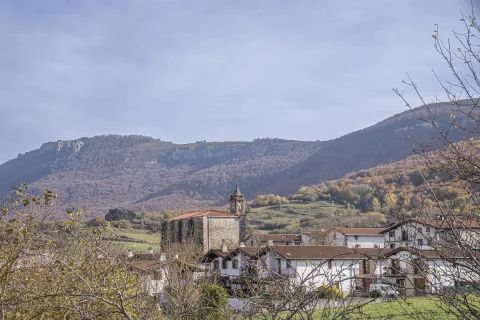
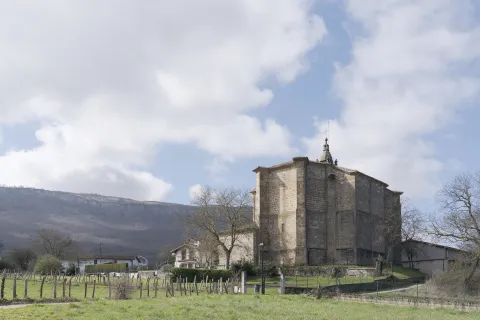
Lakuntza Square with a stone church, traditional architecture, and a modern wood and steel structure.

Lakuntza Square with traditional architecture, mountains in the background, and a cluster of houses on the sides.

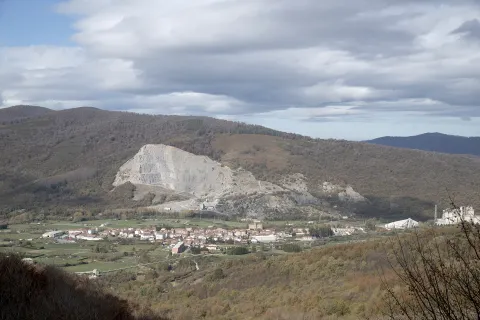
Lakuntza village seen from fields with mountains in the background.
Resuelve las dudas más habituales sobre los diferentes parques y zonas naturales: cómo llegar, qué visitar, normas, rutas y servicios para planificar tu experiencia con facilidad.
According to the official register for 2020, Lakuntza has a population of 1,311 inhabitants. Historically, the town has experienced sustained population growth since the industrial boom of the 1960s.
The Lakuntza festivities are held on several dates: 20 January for Saint Sebastian, with a pilgrimage and the “Alkate Dantza” dance; the Lakuntzako Pertza, on the Sunday after 15 August, with a pilgrimage to San Miguel de Aralar; the fairs, on the third Sunday in August; and Corpus Christi, with a procession and streets covered in herbs and flowers.
Lakuntza is a municipality in Navarre, in the Sakana region. Its name comes from the Basque language and has been interpreted as ‘a place of high ground or a small hill’, although its exact etymology is not entirely certain. It is a town of medieval origin with a strong Basque cultural tradition.
Online
