
Arbizu
Where the plain opens up between the mountain ranges

Where the plain opens up between the mountain ranges
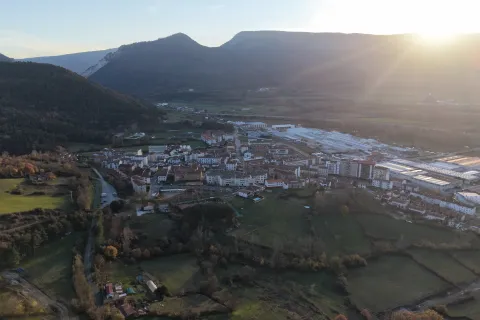
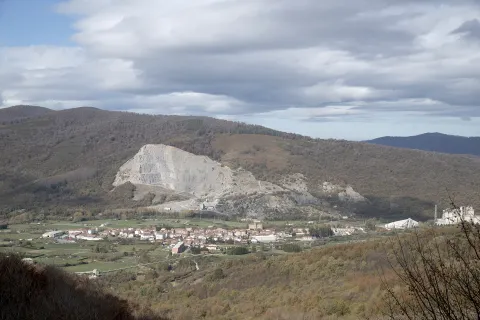
Where the River Leciza flows towards the Burunda and the plain opens up between the Aralar and Andía mountain ranges, the landscape reveals itself in all its simplicity, without artifice. Arbizu is a linear village which, since ancient times, has stood along the route between Pamplona and Vitoria, whilst in its nearby woods lie, discreetly, the remains of ancient megalithic monuments.
It is a land of passage and borders, where pastoral traditions intertwine naturally with stone architecture. The coat-of-arms-adorned façades, the chapels and the town’s very layout reflect a serene continuity, in which every element contributes to a shared narrative deeply rooted in the place.
Arbizu forms part of the region of the Sakana and its municipal area stretches from the heights of Aralar to the vicinity of San Donato. The first documented mention dates from 1268, under the name Arbiçu. For centuries, the town was linked to the Land of Aranaz, until it was granted the title of ‘villa’ in the 16th century.
In 1813, it suffered a major fire during the retreat of French troops, which affected a large part of the village. Today, Arbizu forms part of the Basque-speaking area, where a local variety of Basque with its own distinctive features is preserved. This linguistic continuity is an essential part of the municipality’s cultural identity.
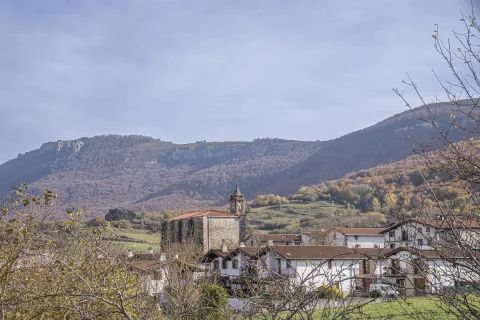
The municipality preserves representative examples of its defensive, religious and productive past.

Arbizu square with medieval stone architecture, a fortified tower and traditional houses.

Cobblestone street in Arbizu with white stone houses and traditional Navarrese architecture and parked vehicles.

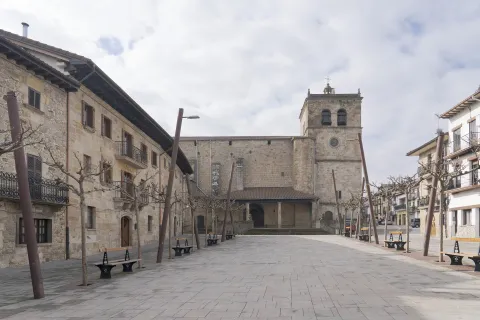
Arbizu square with a bell tower church, stone houses and traditional architecture under a cloudy sky.
Resuelve las dudas más habituales sobre los diferentes parques y zonas naturales: cómo llegar, qué visitar, normas, rutas y servicios para planificar tu experiencia con facilidad.
Chistorra Day (Txistor Eguna) in Arbizu does not have a fixed date every year, but it is usually celebrated in October, on a Sunday, as part of the autumn festival calendar.
In 2025 (latest official data available), Arbizu had 1,107 inhabitants, according to the INE.
The name Arbizu is of Basque origin and means ‘place of turnips’ or ‘field of turnips’, derived from arbi (turnip) and the suffix -(t)zu, which indicates abundance.
Online
