
Olazti / Olazagutía
The mineral threshold between mountain ranges and valley

The mineral threshold between mountain ranges and valley
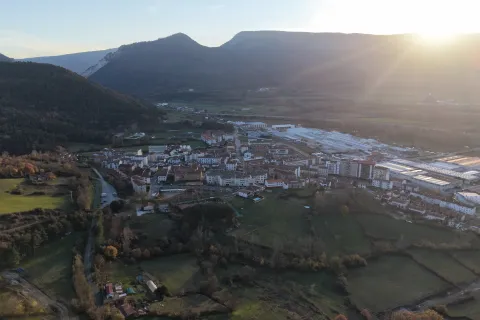
Here, where the River Arakil cuts through a landscape of limestone, forest and industrial traces, time does not move in a straight line: it accumulates. Olazti is defined by the contrast between the hard material of industry and the softness of the vegetation descending from Urbasa, in a strange balance where the mountain and the factory share the same horizon. It is a place of threshold and transit, where the deep geology of Koskobilo, the lime roads and the working-class pulse of the 20th century coexist in a single mineral breath.
Olazti lies at the meeting point of Álava, Gipuzkoa and Navarre itself. Its municipal area, covering 19.6 km², acts as a natural hinge between the Sierra de Urbasa to the south and the Altzania and Otzaurte mountains to the north, with an average altitude of 547 metres.
The area has historically been a strategic transport corridor linking Vitoria, Pamplona and San Sebastián, a factor that has shaped its development. The oldest evidence of human habitation is found at the Koskobilo site, with remains dating from the Middle and Upper Palaeolithic periods.
From the 19th century onwards, the municipality underwent a decisive transformation with the arrival of the railway and the establishment of the Portland Cement factory in 1903, which cemented its industrial character. In 1846, it separated from Burunda to form its own council, establishing the current administrative structure.
Olazti offers a landscape where archaeology, industry and nature intertwine along a single route.

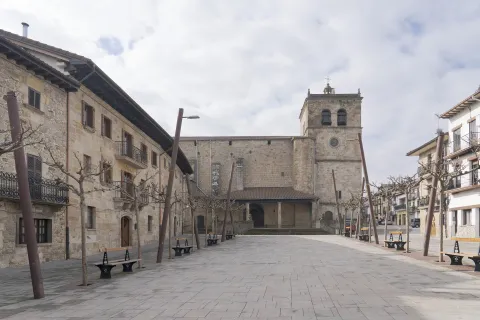
Distinctive building with a domed tower and stone facade in Olazti, surrounded by traditional architecture.

Distinctive building with a domed tower and stone facade in Olazti, surrounded by traditional architecture.

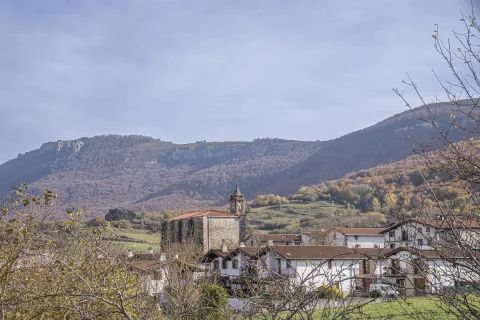
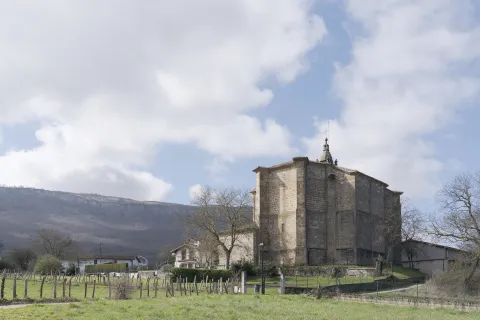
Stone church with a bell tower in Olazti, surrounded by traditional houses and hillside vegetation.
Resuelve las dudas más habituales sobre los diferentes parques y zonas naturales: cómo llegar, qué visitar, normas, rutas y servicios para planificar tu experiencia con facilidad.
According to the official population register consolidated in 2020, Olazti/Olazagutía has a population of 1,490.
Olazti celebrates various traditional festivals throughout the year: highlights include its Rural Carnival with traditional characters and the subsequent urban carnival. On 20 January, they celebrate Saint Sebastian with communal lunches, whilst on 5 February they celebrate Saint Agatha, where the 19-year-olds take centre stage in traditional costumes and with decorated walking sticks.
Olazti/Olazagutía is located in north-western Navarre, within the district of Pamplona and the Burunda region. It is the only major transport hub where the A-1 and A-10 motorways meet, as well as the railway lines connecting with the Basque provinces.
Online
