

The silent valley and the walls that remember
On the hillside where the valley curves, the stones of Bizkaia hold stories that time lets pass in silence. Amongst paths and ancient stone-built settlements, the memory of villages now gone persists in the landscape of the Pre-Pyrenean , like an echo that vibrates in every crumbling wall and every rural church that stands firm. Ezprogui is recognised in the silent density of its abandoned villages and in the solidity of its architecture, a territory that speaks through absence, where the past dictates the rhythm of the present scene and the vestiges of what once was mark the pulse of the valley.
Ezprogui general information
Ezprogui comprises the villages of Ayesa, Moriones and the deserted hamlet that gives the municipality its name. The administrative centre is in Ayesa, whilst Moriones, the former capital of the valley, retains its status as a dependent council. Historical records trace the territory’s origins back to the year 1059, under the name “Ezporogui”, linked to flour milling and the Monastery of Leyre. Life in this municipality extends across valleys and abandoned villages such as La Bizkaia, which has been uninhabited since 1965; its trails now form part of the Tierras de Javier Tourism Consortium, where every stone and every path speaks of an ancient way of life that still beats within.
What to see in Ezprogui?
Ezprogui whispers ancient secrets amongst churches, abandoned villages and footpaths, where the memory of the valley lives on in every stone and forest.
- Lugar de Ezprogui (abandoned village): The hamlet that gives the municipality its name is home to the church of San Juan Evangelista, a rural-style building with a linteled roof featuring exposed beams. Inside, there is a 17th-century image of Saint Helena that still retains part of its original polychromy.
- Ayesa and the church of San Andrés: This village, where the current municipal headquarters are located, has a church of medieval origin rebuilt in the 18th century. Its architecture reflects the adaptation of rural churches to the reforms of the Modern Age.
- Moriones and its administrative heritage: The former capital of the valley retains the layout of its streets and the church of San Martín, which historically housed a Gothic image of the Virgin seated with the Child (currently in the Diocesan Museum). On the road to Loya , one finds the remains of the chapel of La Magdalena, which served as a hospital for pilgrims and the sick.
- Abandoned Villages of Bizkaia: A walk through this valley offers a glimpse of the remains of settlements such as Arteta, Gardaláin, Guetadar, Julio, Loya, Sabaiza and Usumbelz. The ruins of these abandoned villages provide a visual record of the harshness and character of life in the Navarran mountains of yesteryear.
- The La Bizkaia Area: This historic territory, which has been uninhabited since the mid-1960s, is now traversed by footpaths linking the old barns and farmhouses, keeping alive the voice of a valley that has woven its forestry past into the silence of the present-day landscape.

Traditional house in the district of Ayesa, in the municipality of Ezprogui, surrounded by traditional stone architecture.

Ezprogui square with traditional stone buildings and a green-walled fronton.

Stone church with a two-arched bell tower in Ezprogui, under a clear sky.
Preguntas frecuentes
Resuelve las dudas más habituales sobre los diferentes parques y zonas naturales: cómo llegar, qué visitar, normas, rutas y servicios para planificar tu experiencia con facilidad.
The patron saint festivities of Ezprogui are traditionally celebrated on May 15th, coinciding with the feast day of Saint Isidore the Farmer.
Ezprogui is located at a distance of 55 kilometers from the Navarrese capital, Pamplona.
The municipality has very few inhabitants who reside permanently in its lands, primarily distributed between the settlements of Ayesa and Moriones.
You might also be interested in
-
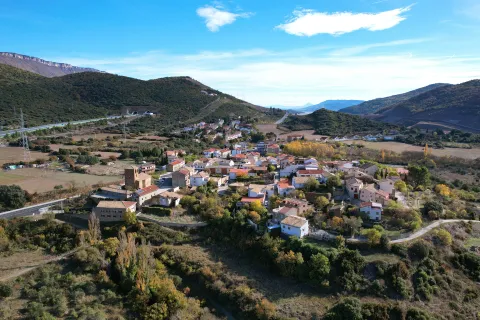
Yesa
The mountain that prays over the waterYesa nestles beneath the sheer slopes of the Sierra de Leyre, … -
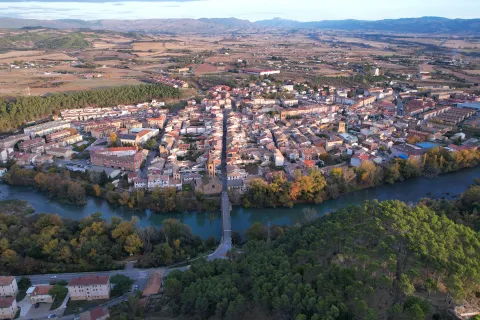
Sangüesa / Zangoza
The stone city that grew up beside the water Sangüesa unfolds upon the terrace of the River Ar… -
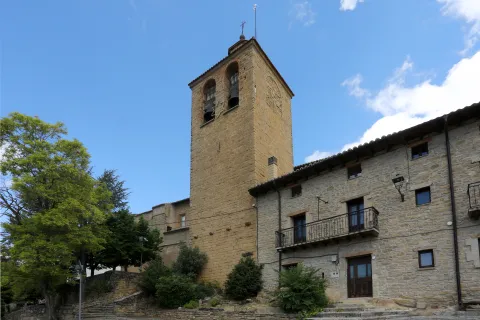
Sada
Where the land recalls the passage of RomeIn Sada, the landscape undulates amongst olive groves and … -
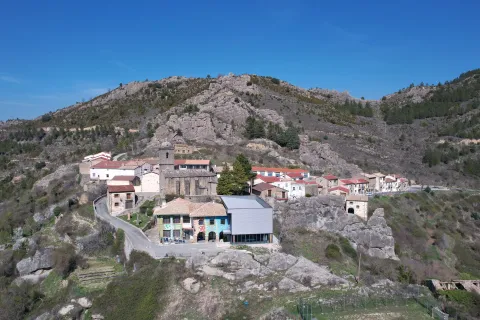
Petilla de Aragón
The border carved in stoneHere, the contours of the Sierra de Peña trace the outline of our insular …
AltaNavarra Chat
Online
