
Uztárroz / Uztarroze
Where snow writes and stone remains

Where snow writes and stone remains
Here, on the northernmost edge of the Roncal Valley, where the light arrives first and winter leaves its deepest mark, time does not move forward: it settles. In Uztárroz, stone supports not only the houses, but also the memory of those who learned to live at high altitude. The slope of the roofs converses with the snow, and the silence of the landscape opens out towards the passage between valleys. It is a land where the mountains breathe slowly, where transhumance can still be sensed on the paths, and where water, in its most discreet form, accompanies life without imposing itself. Here, everything remains effortlessly.
The village rises to an altitude of 869 metres, making it the highest and northernmost settlement in the Valle de Roncal. Its territory, vast and borderland, extends to the French border, forming a landscape where the peaks rise above 1,900 metres and the horizon is fragmented by mountains. The history of Uztárroz is linked to the defence of the territory and the communal organisation of the valley. Since the Middle Ages, its inhabitants have played an active role in guarding the border, leaving a legacy of strength that is still evident in their character. Today, life remains rooted in livestock farming and cheese-making, maintaining a direct connection with the surrounding environment. Basque remains a living presence, and the memory of Fidela Bernat is preserved as one of the last echoes of the Roncal dialect.
The town’s heritage reveals an intimate connection between tradition, architecture and nature.

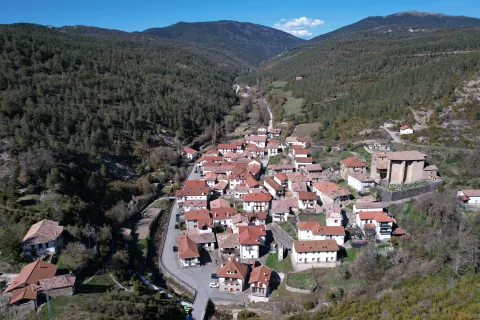
Cobblestone street in Uztarroz with stone houses and small red roofs typical of Navarrese Pyrenean architecture.

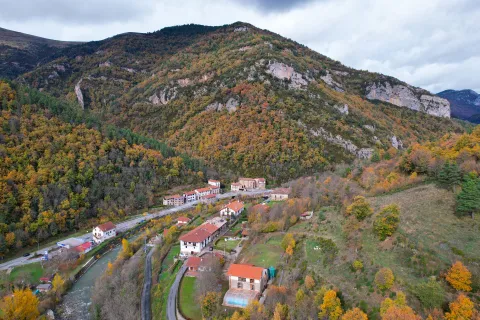
Uztarroz village with stone houses by a river, surrounded by mountain forest in autumn.

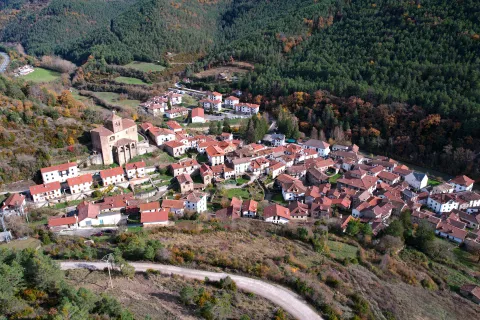
Stone and white church with a bell tower in Uztarroz, surrounded by Pyrenean forest in autumn.
Resuelve las dudas más habituales sobre los diferentes parques y zonas naturales: cómo llegar, qué visitar, normas, rutas y servicios para planificar tu experiencia con facilidad.
It is located in the northeast of Navarra, being the northernmost village in the Roncal Valley. It is 104 kilometers from Pamplona and directly borders the French frontier via the Laza pass.
Online
