
Isaba / Izaba
Where the mountains watch over and the water carves out the paths

Where the mountains watch over and the water carves out the paths
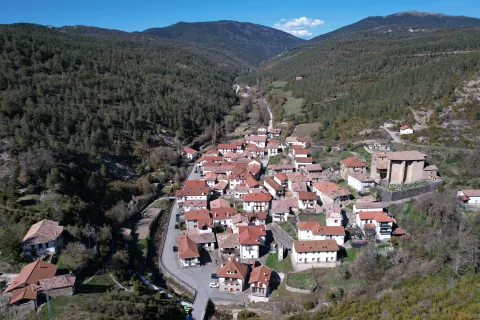
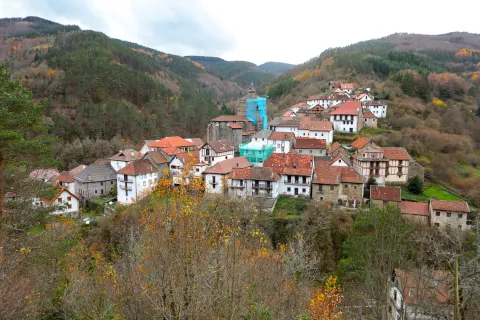
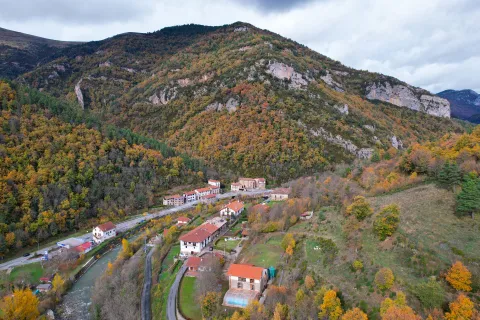
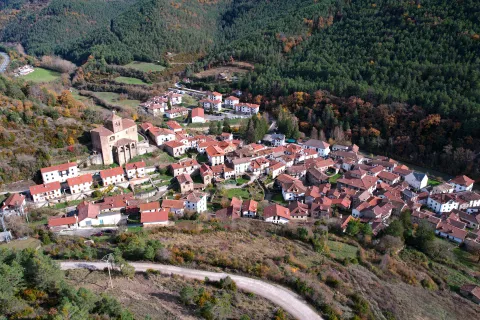
At the point where three streams—Uztárroz, Belagua and Belabarce—converge to form a single flow, time does not pass: it gathers. Under the constant gaze of the Mesa de los Tres Reyes, the landscape is organised into layers of stone, water and memory. In Isaba, the atmosphere is felt in the solidity of the farmhouses, in the coats of arms that still watch over the façades, and in the slope of the roofs, designed to ensure the snow does not linger. It is a land of borders and contemplation, where the echo of the shepherds and the depth of the Pyrenees create a stillness that is not absence, but contained presence. Here, every stream and every cobbled street reveals an identity waiting to be discovered.
Isaba stands at an altitude of 816 metres, at the northernmost tip of the Roncal Valley ( ), where the territory reaches its greatest expanse and its most mountainous character. Covering an area of 147 km², Isaba is one of the largest municipalities in Navarre and forms the natural border with France and Aragon. Within its boundaries rises the Mesa de los Tres Reyes (2,428 m), the highest point in the region, where territories and histories converge.
The identity of the place is marked by resilience: fires, wars and reconstruction have left their mark on its current landscape. Added to this is a collective nobility that has defined the character of its inhabitants since the 15th century. Today, Isaba preserves the legacy of the Roncales dialect of Basque, spread across its six neighbourhoods —Barrikata, Izarjentea, Burgiberria, Bormapea, Garagardoia and Mendigatxa—, where life continues to adapt to the rhythm of the mountains.
What you’ll discover here are living traces of an identity shaped by water and altitude.

Detail of a stone arch and access staircase in Isaba, with decorative ornamentation above the arch and views towards the interior.

Church with a stone bell tower dominates the snowy landscape of Isaba, surrounded by traditional white Pyrenean houses.

Snow-covered dolmen in the Isaba valley, surrounded by a snowy Pyrenean forest.
Resuelve las dudas más habituales sobre los diferentes parques y zonas naturales: cómo llegar, qué visitar, normas, rutas y servicios para planificar tu experiencia con facilidad.
According to the official register of INE 2025, the village has a population of 384 inhabitants, being the most numerous community in the Roncal Valley.
Online
