
Ziordia
Where the landscape learns to be still

Where the landscape learns to be still
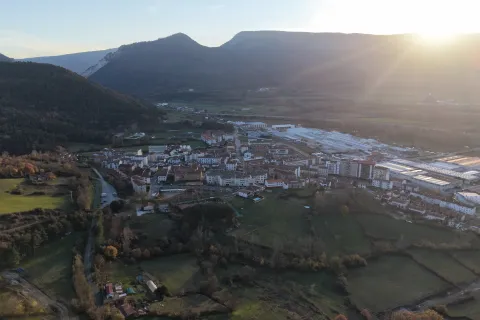
On the unassuming border where the Burunda River winds its way towards Álava and Gipuzkoa, Ziordia stands as a place of slow passage. The stone holds the valley’s memory, and the River Arakil continues its course as if simply following an ancient command that no one has ever written down.
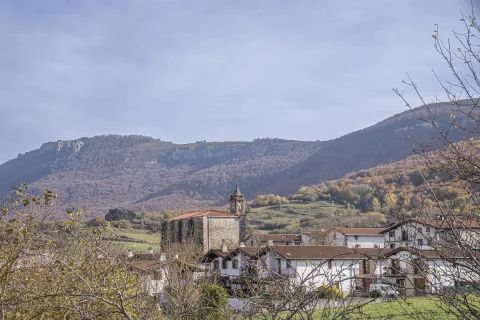
Here, traditional architecture watches from large stone-built houses that seem to have learnt to keep silent, whilst the Altzania and Urbasa mountain ranges define the horizon as if guarding it. It is not a place that reveals itself all at once, but in layers: in the calm of the landscape, in the daily lives of its inhabitants and in the quiet continuity of its identity in the Sakana.
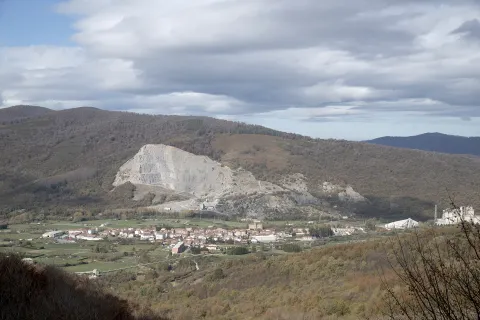
Ziordia lies at an altitude of 553 metres on the western edge of Navarre, forming an essential part of the Sakana region. Its municipal area stretches along the left bank of the River Arakil, between the silhouette of the Tres Mugas peak to the north and the Urbasa mountain range to the south. Although Ziordia was linked to the ancient town of Burunda centuries ago, the town was established as an independent municipality in 1846.
The area retains traces dating from prehistoric times to documented events of the Middle Ages, such as the donation of toll revenues made by John II in 1462. It also preserves the memory of the witchcraft trials recorded between 1575 and 1576, which form part of the social history of the region. Today, Ziordia belongs to the Basque-speaking area of Navarre, where the Basque language remains an active part of the cultural landscape.
A tour of Ziordia reveals layers of history where the sacred, the civil and the ancestral coexist, creating a journey where each element refers to a different era in the valley’s history.

Traditional stone house in Ziordia with a front fountain and a stone wall in front.

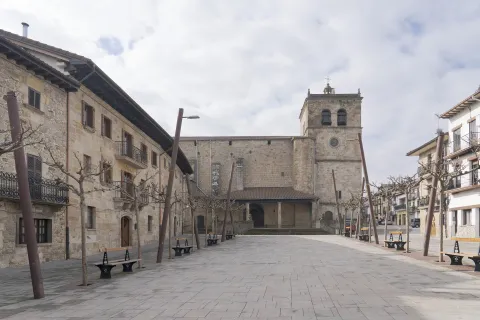
Ziordia Town Hall, a traditional stone building, with a church in the background and bare trees in spring.

Cluster of white stone houses in Ziordia with snowy mountains in the background.
Resuelve las dudas más habituales sobre los diferentes parques y zonas naturales: cómo llegar, qué visitar, normas, rutas y servicios para planificar tu experiencia con facilidad.
The surname Ciordia derives from the name of the municipality. Its etymological origin lies in the Basque word zihaurri (yezgo), the suffix -di (abundance) and the article -a. Its meaning would be ‘the yezgal’ or ‘place of yezgo’.
The patron saint’s festivities are held around 8 September in honour of the Virgin of the Choir and last for about five days, during which cultural and traditional activities take place, such as the distribution of wine and cheese.
According to the official INE census for 2025, Ziordia has a population of 359.
Online
