
Uharte Arakil
Between surrounding waters and watchful mountains

Between surrounding waters and watchful mountains
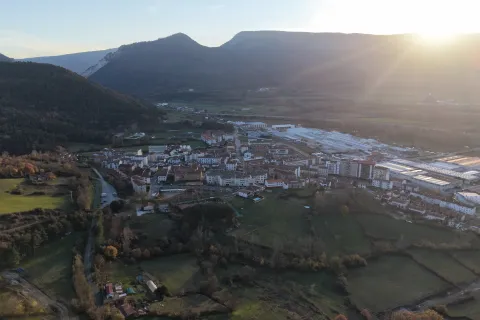
Where the Arakil turns in on itself and traces gentle curves across the plain, Uharte Arakil emerges as a space defined by water and its persistence. It is not the river that flows through the village, but the village that seems to adapt to its shape, as if it had always been contained within that gesture.
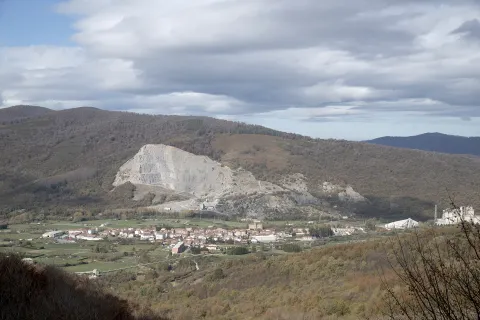
On the horizon, the Aralar mountain range rises with a constant presence, elevating the sanctuary of San Miguel as a landmark that transcends the visible. Between the valley’s horizontal expanse and the mountain’s vertical height, the landscape finds its balance in a serene tension.
Here, the ancient paths (Roman, pastoral, pilgrimage) have not disappeared entirely, but remain as invisible lines that still order the landscape. Uharte Arakil is not explored in haste: it is understood by following the rhythm of the water and the memory it carries with it.
Uharte Arakil is situated in the heart of the Sakana region, some 32 kilometres from Pamplona. Its municipal area, covering 38.17 km², occupies a strategic position in a natural narrowing of the valley, where the course of the river has historically shaped its development.
The town’s origins date back to the ancient Roman mansio of Aracaeli, linked to the road connecting Astorga with Bordeaux. This history has been documented in the vicinity of Zamartze Monastery, where archaeological evidence from that period has been found.
Today, the town has 770 inhabitants (2025) and forms part of the Basque-speaking area of Navarre. The Basque language remains present in everyday life, whilst traditional activities such as sheep farming maintain a direct link with the pastures of the Aralar mountain range.
A tour of Uharte Arakil combines Romanesque architecture, historical routes and mountain scenery.

Medieval stone bridge over a river in Uharte Arakil with stone houses in the background, surrounded by autumnal vegetation.

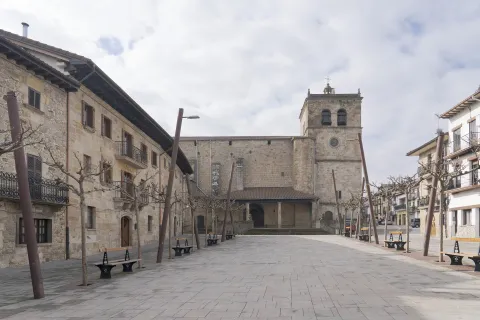
Square with stone walls and benches in Uharte Arakil, with trees, iron lampposts, and a church in the background.

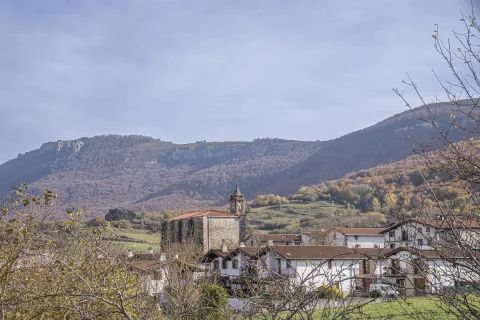
Stone church with a bell tower in Uharte Arakil's square, surrounded by trees and traditional architecture.
Resuelve las dudas más habituales sobre los diferentes parques y zonas naturales: cómo llegar, qué visitar, normas, rutas y servicios para planificar tu experiencia con facilidad.
Uharte Arakil is accessible via the A-10 motorway (exits 11 and 12). There are also bus and train connections.
Highlights include Artzai Eguna (Shepherd’s Day), held on the last Sunday in August, and the patron saint’s festivals in June (San Juan) and September (San Miguel). Hiking and mountaineering are also popular activities.
It means ‘between waters’ in Basque (ur arte), referring to its location amongst meanders or watercourses. ‘Arakil’ derives from the historical name linked to the ancient Roman mansio of Aracaeli.
Online
