
Etxarri Aranatz
The town set amidst stone and forest

The town set amidst stone and forest
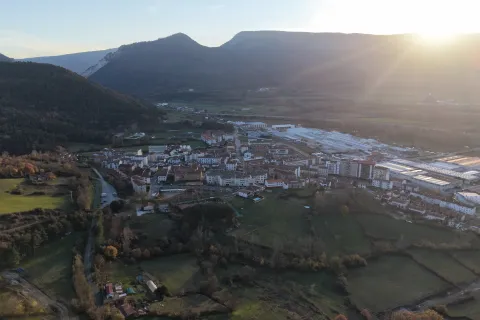
Here, at the point where the Araquil river winds its way between the natural walls of Aralar and Urbasa, the valley stretches out like a long, sustained breath, flanked by ancient oak groves. Etxarri Aranatz was founded in 1312 as a response to the scattered emptiness of the valley, concentrating life within an urban layout that still retains something of its original purpose. Its straight streets, its measured pace and the traces of ancient defences suggest an order designed to endure.
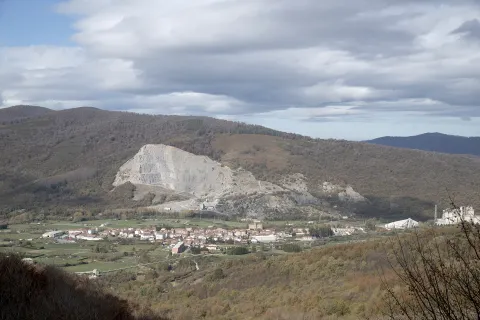
Between the stone and the forest, the territory reveals its essence: the persistence of the oak trees, the tranquillity of the chapels and the memory buried in the rock. Here, daily life unfolds without disrupting the place’s ancient rhythm, as if the valley were still writing its own story.
Etxarri Aranatz is situated in the heart of the Sakana , some 40 kilometres from Pamplona. Its location, on the right bank of the River Araquil, makes it one of the main centres of the Tierra de Aranatz, alongside the municipality of Lizarragabengoa.
The town was founded in the 14th century with the aim of reorganising the scattered population of the valley, bringing together ancient settlements that have since disappeared. Its layout reflects this intention of concentration and order, which is still visible in the structure of the town centre.
Today, it belongs to the Basque-speaking area of Navarre, where Basque remains a living language in everyday life. With 2,551 inhabitants (2025), the municipality is set in a landscape dominated by an Atlantic climate that nourishes forests of beech, oak and chestnut trees, the natural foundation of the landscape and its identity.
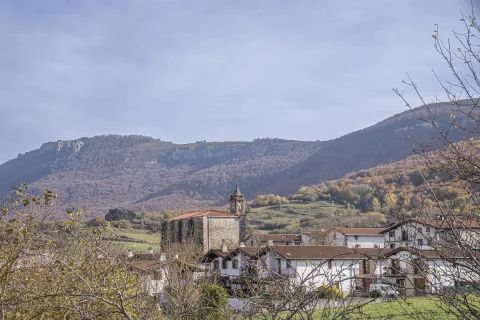
Etxarri Aranatz preserves a valuable historical legacy evident in its religious architecture, its medieval town centre and its cultural routes. Churches, chapels and natural landscapes reflect the valley’s evolution and its close relationship with the surrounding environment.

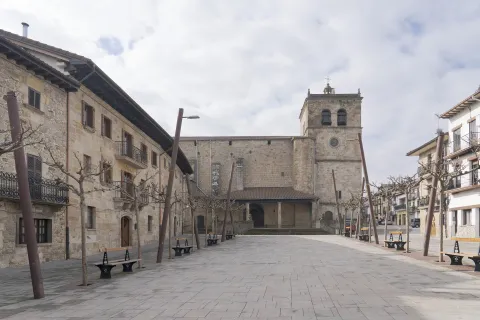
Etxarri Aranaz square with pruned trees and modern urban furniture, church in the background.

Wooden and steel structure with a curved roof in Etxarri Aranaz square, with trees and buildings around.

Twisted tree trunk in a roundabout in Etxarri Aranatz, with stone buildings and flags in the background.
Resuelve las dudas más habituales sobre los diferentes parques y zonas naturales: cómo llegar, qué visitar, normas, rutas y servicios para planificar tu experiencia con facilidad.
The Church of the Assumption, the Dolmen Trail, the Chapel of the Immaculate Conception and the Ancient Oaks are the main points of interest that you shouldn’t miss if you visit Etxarri Aranatz.
There are two main interpretations of the name Etxarri: ‘stone house’ (etxe + harri) or ‘new house’ (Etxaberri, according to philological studies). ‘Aranatz’ refers to the valley.
In Etxarri Aranatz, the main celebrations take place around Carnival and the Maiatza festival, as well as other local pilgrimages and fairs throughout the year.
Online
