

The Baztan and Bidasoa Valleys
Where the landscape becomes a story
Here, where the mountains lean their silhouettes towards the Cantabrian Sea and the water flows as if it had always been waiting, time does not pass: it breathes. Among meadows of a green that seems to know no winter, the streams murmur an ancient language that only the landscape understands. In the Baztan and Bidasoa Valleys, the dappled shade of the beech woods preserves the shape of memory, and the farmhouses of reddish ashlar stone hold the stillness as if they were part of the land itself. Everything here belongs to the same substance: that of the forest, the stone and the shared silence.
Baztan and Bidasoa Valleys general information
This is a region in the north-west of Navarre, in the Atlantic Pyrenees, covering an area of approximately 830 km² characterised by nature and rural heritage. Its identity stems from the union of the Baztan Valley and the Bidasoa region, which encompasses Baztan, Bertizarana, Bortziriak, Malerreka and the Urdazubi/Urdax and Zugarramurdi valleys.
Its history is linked to life on the border and a deep connection to the land, reflected in the palaces of the ‘cabo de armería’ and the homes of the ‘indianos’ who transformed the landscape upon their return from overseas. The mild, humid oceanic climate favours the coexistence of Atlantic species such as beech and oak alongside unique crops such as kiwi fruit and palm trees. It is a region where the Basque language, traditional crafts and sports form a living part of everyday life.
How to get to the Baztan and Bidasoa Valleys?
The main route to the valleys is via the N-121-B road, which crosses the Baztan from south to north and connects with the towns of the Bidasoa River’s.
- From Pamplona: It is located about 54 kilometres from the capital of Navarre.
- From San Sebastián: The distance is approximately 64 kilometres.
- From the border: Towns such as Amaiur, Bera and Urdax are just a few minutes’ drive from the border crossings with France.
What to do in the Baztan and Bidasoa Valleys?
Here, the landscape is interpreted as an ancient language written in water, forest and stone.
- Exploring the forest: Places such as the Señorío de Bertiz Natural Park offer trails for observing Atlantic biodiversity and a historic garden that is home to unique species such as redwoods and ginkgo trees.
- Exploring the underground: The flow of water has carved out the Urdax Caves, formed 14,000 years ago, and the Zugarramurdi Caves, where the karst formations preserve the memory of the akelarres.
- Exploring the greenways: The old route of the ‘Tren Txikito’ is now the Bidasoa Greenway, allowing you to experience 35 kilometres of riverside landscape on foot or by bike.
- Watch the milling: The eco-museums at the mills of Zubieta, Urdax and Amaiur keep alive the essence of grain and the hydraulic power that sustained the valley for centuries.
- Taste the tradition: Everyday life is brought to the table with products such as Idiazabal PDO cheese, curd, Elizondo chocolate and dishes such as Baztan Soup or beef steak.
Información sobre: The Baztan and Bidasoa Valleys
-
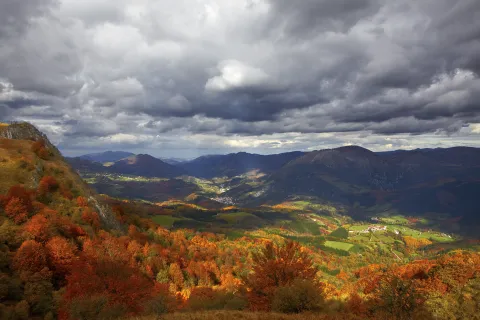
Araitz Valley
Here, where the mountain seems to lean in to listen to its own echo and the Malloas cut across the s… -
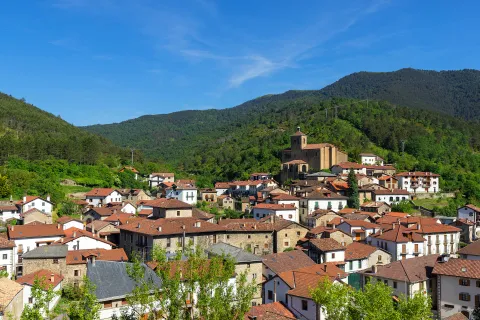
Roncal Valley
Here, where the landscape bears the mark of Navarre’s only glacial valley and the River Esca marks t… -
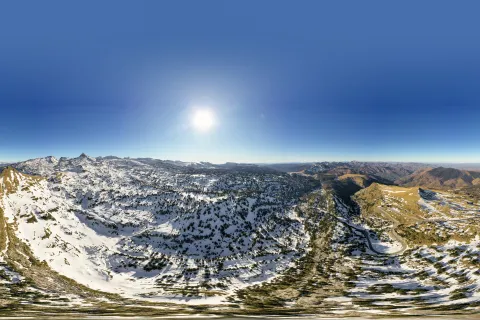
Belagua Valley
Here, where ancient ice left its mark on the only glacial valley in this land and the limestone of L… -
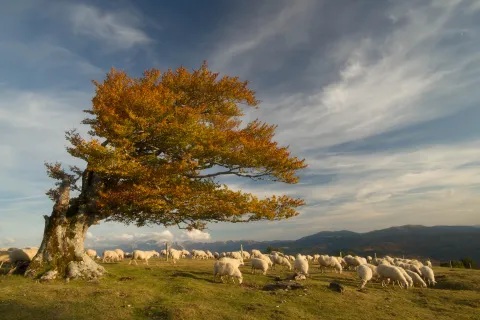
Salazar Valley
Here, where the river that gives it its name winds its way down through the shade of beech trees and…
