

Roncal Valley
Where the mountains hold their memories
Here, where the landscape bears the mark of Navarre’s only glacial valley and the River Esca marks the pulse of life between rock and black pine, time is not measured: it lingers. In the Roncal Valley, peaks over two thousand metres high stand alongside the silence of the bordas, guardians of centuries of transhumance. It is a land of deep roots, where the karst of Larra and the steadfast presence of my seven villages coexist in a harmony that reveals itself slowly, as if the Pyrenees were breathing through every stone.
Roncal Valley general information
The Roncal Valley lies at the eastern end of the Navarran Pyrenees, bordering France and Aragon in a high-mountain setting. It covers an area of 411 km², criss-crossed from north to south by the River Esca, which acts as its backbone. The valley has been inhabited since the Neolithic period, home to monuments such as the Arrako dolmen, a remnant of a millennia-old pastoral culture.
Administratively, the Roncal Valley is organised as an association of seven traditional villages that keep their own culture and identity alive. The terrain is predominantly mountainous, home to the highest peak in the region: the Mesa de los Tres Reyes (2,428 m). The land is mainly sustained by mountain livestock farming, forestry and a form of tourism that seeks to experience the authenticity of the Pyrenean landscape.
How to get to the Roncal Valley?
The most direct route to the valley is to follow the course of the River Esca from its source at the Yesa reservoir.
- Main routes: The NA-137 road is the main route through the valley, connecting its towns— Burgui, and —all the way to the Belagua Pass on the French border.
- Entry points: To reach the valley, you leave the provinces of Zaragoza and Huesca behind and enter via the Foz de Burgui.
What to do in the Roncal Valley?
In the valley, every corner offers a different way of understanding the mountains.
- Exploring its villages: A place to appreciate the solidity of the stone and timber in villages such as Isaba , Roncal —birthplace of the tenor Julián Gayarre— or Burgui.
- Observing nature: A region where you can witness the contrast between the Belagua Valley (the region’s only glacial valley) and the Larra karst massif, one of the largest in Europe.
- Celebrating traditions: Every 13 July, the Tribute of the Three Cows can be witnessed at the Piedra de San Martín, the oldest international treaty still in force in Europe. The Day of the Almadía is also celebrated in May, paying tribute to the ancient river transport of timber.
- Mountain activities: The terrain is ideal for cross-country skiing at the Larra-Belagua centre, mountaineering to the peaks, or cycle touring on MTB and Enduro routes.
- Astrotourism: The valley holds the Starlight Tourist Destination certification, making it a prime location for observing the starry sky free from light pollution.
Information about: Roncal Valley

Roncal Valley | Roncal

Roncal Valley | Roncal

Roncal Valley | Roncal
-
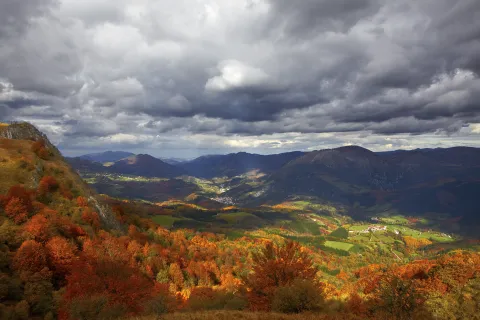
Araitz Valley
Here, where the mountain seems to lean in to listen to its own echo and the Malloas cut across the s… -
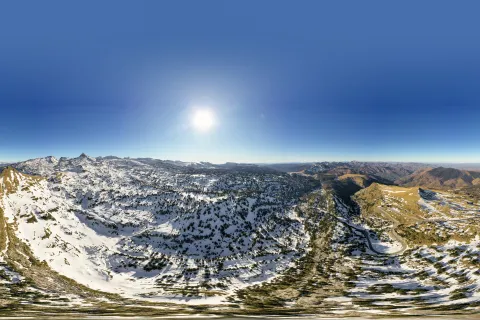
Belagua Valley
Here, where ancient ice left its mark on the only glacial valley in this land and the limestone of L… -
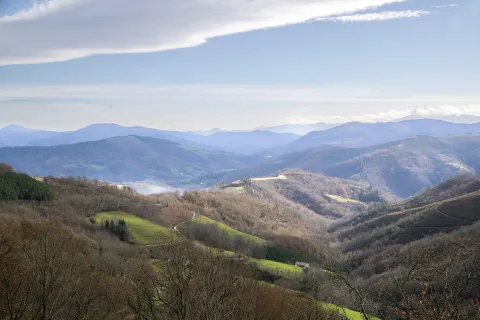
The Baztan and Bidasoa Valleys
Here, where the mountains lean their silhouettes towards the Cantabrian Sea and the water flows as i… -
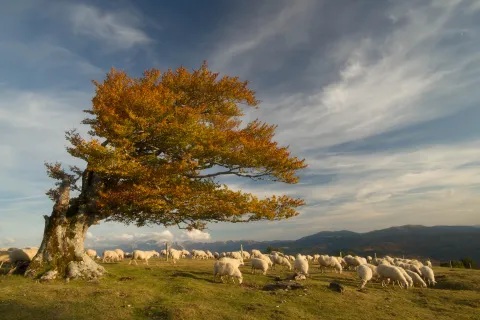
Salazar Valley
Here, where the river that gives it its name winds its way down through the shade of beech trees and…
