

Belagua Valley
The whisper of ice and the memory of stone beneath the Mesa de los Tres Reyes
Here, where ancient ice left its mark on the only glacial valley in this land and the limestone of Larra splits into endless crevices, time does not move forward: it stands still. Amidst tall pastures and peaks that touch the sky, life in the Belagua Valley flows with the calm of the essential. Its atmosphere is filled with the murmur of the River Belagua as it crosses the plain and the silence of the barns, witnesses to centuries of pastoral life. It is a land where the flight of the bearded vulture and the steadfastness of the black pine coexist in harmony, gradually revealing the purest essence of the Pyrenees.
Belagua Valley general information
The valley is situated at the northern end of the Roncal Valley, bordering directly on France and Huesca, right in the heart of the Navarrese Pyrenees. Its identity is shaped by a high-mountain landscape that rises from 1,100 metres to 2,428 metres at the Mesa de los Tres Reyes, the highest point in Navarre.
The history of the Belagua Valley dates back to ancient times, with traces of human settlement from the Bronze Age, visible in megalithic remains such as the Arrako dolmen. It forms part of the municipalities of Isaba , although its essence belongs to the Roncal Valley as a whole. For centuries, life here has been linked to pastoralism, leaving its mark on the mountain huts and on products such as Roncal cheese.
How to get to the Belagua Valley?
Access to the valley is mainly via the town of Isaba, which acts as a natural gateway.
- By road: Access is via the NA-137, a road that crosses the plain and climbs up the Belagua Pass towards the French border.
- Landmarks: The climb takes in landmarks such as the Venta de Juan Pito or the Piedra de San Martín area, situated at an altitude of over 1,750 metres.
What to do in the Belagua Valley?
The valley invites you to experience the mountains from within, combining nature, physical activity and tradition.
- Cross-country skiing and snowshoeing: In winter, the Larra-Belagua resort offers over 22 kilometres of marked trails in areas such as El Ferial and La Contienda, allowing you to explore the snow-covered landscape.
- Summit ascents: A region for advanced mountaineering where you can tackle peaks such as Pic d'Anie (2,507 m), Kartxela, Arlás or the Mesa de los Tres Reyes.
- Caving: The limestone formations of Larra feature world-renowned chasms, notably the Piedra de San Martín, with a vertical drop of over 1,200 metres.
- Wildlife watching: A prime spot for spotting unique species such as the capercaillie, rock partridge, brown bear and chamois.
- Rites and Traditions: Every 13 July, the Tribute of the Three Cows takes place at Piedra de San Martín, considered the oldest existing cross-border treaty in Europe.
Information about: Belagua Valley

Belagua Valley and Larra Natural Reserve | Arrakagoiti Canyon

Belagua Valley and Larra Natural Reserve | Belabarce

Belagua Valley and Larra Natural Reserve | Belabarce Waterfall
-
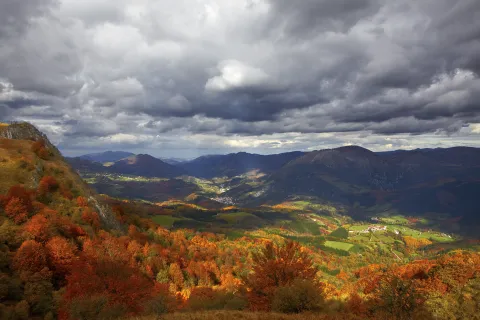
Araitz Valley
Here, where the mountain seems to lean in to listen to its own echo and the Malloas cut across the s… -
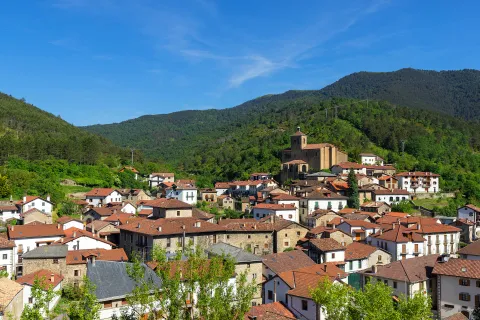
Roncal Valley
Here, where the landscape bears the mark of Navarre’s only glacial valley and the River Esca marks t… -
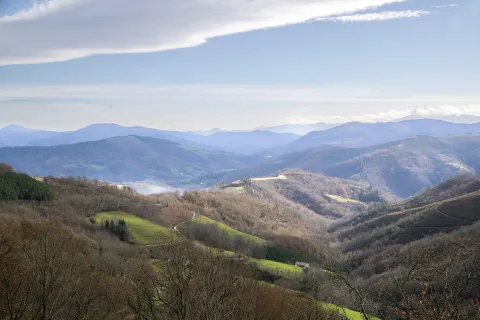
The Baztan and Bidasoa Valleys
Here, where the mountains lean their silhouettes towards the Cantabrian Sea and the water flows as i… -
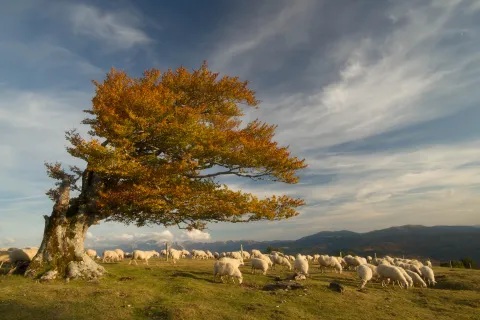
Salazar Valley
Here, where the river that gives it its name winds its way down through the shade of beech trees and…
