
Ultzama
Where the mist holds the valley’s memory

Where the mist holds the valley’s memory
Here, where the name of the land whispers of an ancient origin linked to the heights and the landscape unfolds like a tapestry of meadows and beech woods, time stands still. In Ultzama, the atmosphere is reflected in the mist that envelops the damp oak groves of Orgi and in the tranquillity of the peaks that silently separate two worlds of water: the Cantabrian and the Mediterranean. I am a land of deep roots, where the stone of the stately homes and the murmur of the rivers Ultzama and Arkil coexist in a slow harmony, allowing the identity of the fourteen villages as one —Hamalau bat— to reveal itself effortlessly.
The valley lies in the north-west of Navarre, forming part of the Ultzamaldea region and situated some 25 kilometres from Pamplona. Ultzama’s identity is rooted in an area of approximately 96–98 km², which forms a transitional slope between the Atlantic and Mediterranean regions of Navarre. The terrain, which is not particularly rugged and is covered in abundant vegetation, has an average altitude of 542 metres, rising to 1,145 metres on the border with Lanz .
Its history records human presence dating back over 15,000 years and an administrative history established in the 11th century, receiving its charters from Sancho VII the Strong in 1211. Administratively, it is situated in the Basque-speaking area, where the Basque language is a living trace of its everyday culture. In Ultzama, daily life is rooted in the land through cattle, sheep and horse farming, which provides the raw ingredients for our renowned cuisine.
In Ultzama, landscape and history intertwine in a dialogue that is felt rather than seen.
The Ultzama valley reveals itself through the villages that inhabit it, each one a guardian of a part of its history.

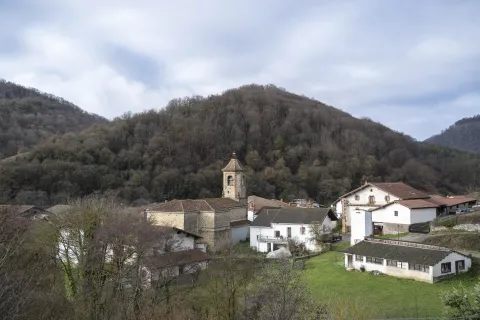
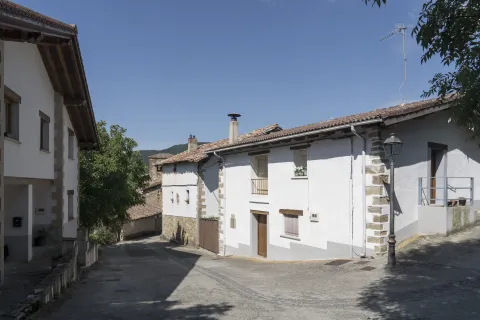
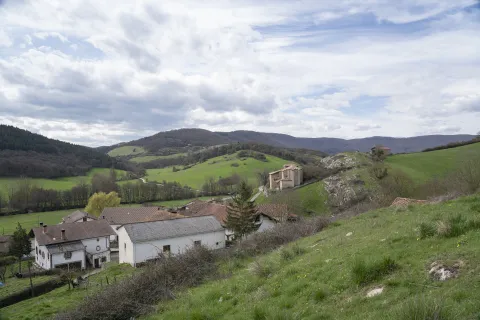
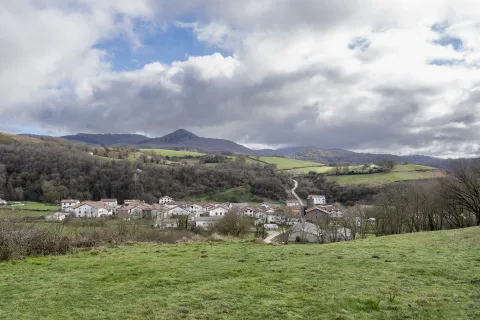
A village in the Ulzama valley surrounded by green meadows and wooded mountains.

A village in the Ulzama valley surrounded by green meadows and wooded mountains.

Villages of Ultzama Valley with a bell tower church surrounded by green meadows and mountain forests in the background.
Resuelve las dudas más habituales sobre los diferentes parques y zonas naturales: cómo llegar, qué visitar, normas, rutas y servicios para planificar tu experiencia con facilidad.
The local produce of Ultzama is particularly evident in the curd made from Latxa sheep’s milk and the smoky flavour, as well as the mushrooms, game and local meats.
It derives from the Celtic root Uxama, which means ‘the highest’, referring to its position as one of the highest valleys on the watershed.
The area is ideal for mushroom picking in the dedicated park, hiking through the Orgi Forest, playing golf or walking the Baztan Route of the Camino de Santiago.
According to the official register for the year 2025, the community has a population of 1,599 inhabitants.
It is situated in the north of Navarre, around 22–24 kilometres from Pamplona, within the Ultzamaldea region and bordering valleys such as the Baztán and the Basaburua.
Online
