
Olaibar
The murmur of the Ultzama among the mountains

The murmur of the Ultzama among the mountains
Here, where the River Ultzama winds its way through pine forests and limestone rises in ridges that fold the horizon, time does not move forward: it lingers. In Oláibar, the atmosphere dwells in the stillness of the ancient stones and in the whisper of the beech woods that guard the heights. It is a land of passage and contemplation, where the pulse of the flysch and everyday life intertwine in a mineral harmony that reveals itself only to those who know how to linger, letting the mountain and memory speak without haste.
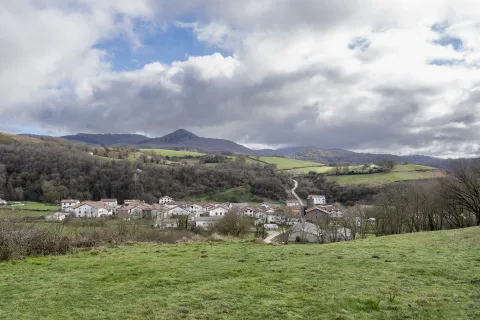
Oláibar lies at the heart of Navarre, within the Ultzamaldea region and a mere 11 kilometres from Pamplona. My identity is rooted in a landscape criss-crossed from north to south by the waters of the River Ultzama, which defines the character of the territory.
Historical records mention it as a valley as far back as 1268. Administratively, it was established as a municipality in a mixed-language area, where Basque and Spanish are living vestiges of its everyday culture. Its economy continues to be rooted in the land, primarily through the primary sector, with livestock farms and the management of communal woodlands. It has a sub-Atlantic climate with abundant rainfall that nourishes a varied vegetation of oaks, beeches and the westernmost extent of Scots pine in the region.
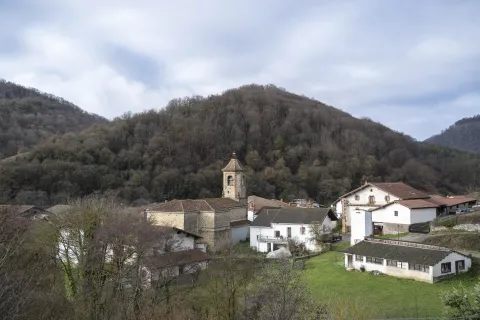
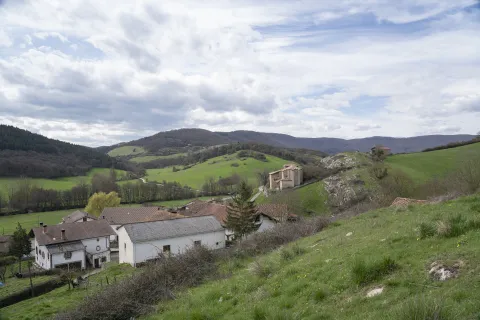
The landscape of Oláibar reveals an ancient dialogue between stone, faith and the silence of the forest.

Olaibar street with traditional stone architecture and white facade, in Plazaola-Sakana-Ultzamaldea.

Rural Romanesque stone church with a two-opening bell tower in Olaibar, in Plazaola-Sakana-Ultzamaldea.

Cobblestone street in Olaibar with traditional Basque-Navarrese farmhouses, white walls, and wooden balconies.
Resuelve las dudas más habituales sobre los diferentes parques y zonas naturales: cómo llegar, qué visitar, normas, rutas y servicios para planificar tu experiencia con facilidad.
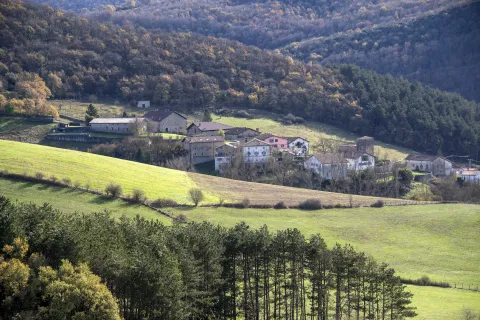
Oláibar has a sub-Atlantic climate with abundant rainfall that nourishes a varied vegetation. Its landscape is home to Scots pine forests, oak groves and beech woods, forming a bioclimatic crossroads where the forest is the foundation of the landscape.
Etymologically, its name derives from the Basque words ola (hut or smithy) and ibar (valley), meaning ‘valley of the smithy’ or ‘valley of the hut’.
The area invites you to experience the landscape through observing cultural traditions such as charcoal burning or the chestnut season. You can also explore the terrain by hiking the slopes of Ortxikasko or visiting the medieval settlement that overlooks the valley.
According to the latest census data from the INE for 2025, the village has a total population of 399 inhabitants.
Online
