
Atez / Atetz
The whisper of the valley amongst oak trees and ancient paths

The whisper of the valley amongst oak trees and ancient paths
Here, where the ancient name of the land still whispers of a narrow pass and the River Ubeldea traces the serene pulse of the fertile plain, life unfolds without haste amongst damp meadows and deep oak groves. In Atetz, the atmosphere is felt in the silent resilience of the farmhouses against the rain and in the stillness of the beech woods that embrace a landscape shaped by time.
It is a land of deep-rooted traditions and contemplation, where timber, the mule-drivers’ paths and the memory of daily labour intertwine in discreet harmony, allowing the identity of Ultzamaldea to emerge without artifice.
Atetz is situated near the capital of Navarre, where the landscape undulates gently between open fields and woodlands. At an average altitude of 572 metres, my territory spans just over 26 km², home to beech woods, holm oak groves and reforested pine stands.
The history of Atetz dates back at least to the 12th century, when some of its present-day settlements were already mentioned. Today it is a municipality comprising several local councils, where life is organised in a dispersed yet connected manner. In 2023, it officially adopted its bilingual name, reflecting an identity deeply rooted in the Basque language, a language that continues to be present in the place names and in the daily lives of the town’s inhabitants.
The valley reveals a heritage where geology, architecture and traditional ways of life intertwine, inviting a leisurely exploration of the area.
My territory is made up of various settlements, each preserving a part of my mineral identity:

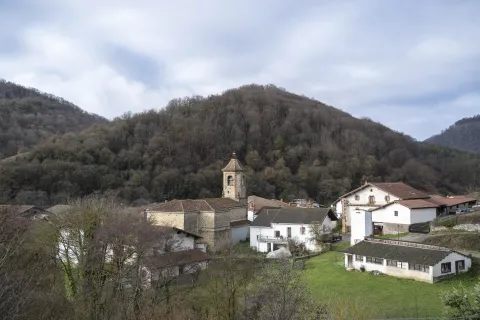
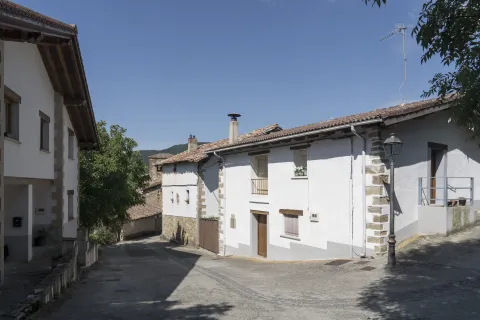
Stone rural house in Atez with traditional Navarrese architecture, winter trees, and an access road.

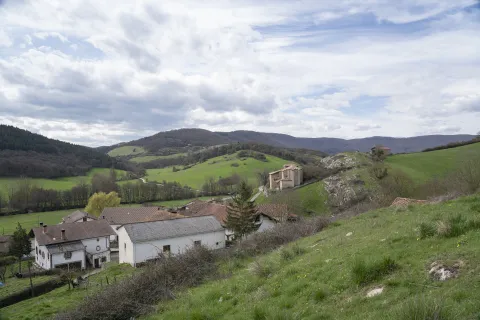
Traditional houses and green meadows in the Atez valley, with sheep grazing and a cloudy sky.

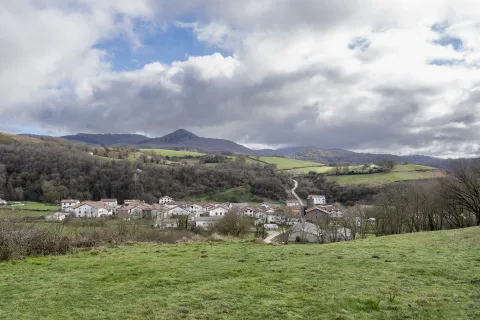
Village of Atez with stone houses, surrounded by natural vegetation and green meadows.
Resuelve las dudas más habituales sobre los diferentes parques y zonas naturales: cómo llegar, qué visitar, normas, rutas y servicios para planificar tu experiencia con facilidad.
The area invites you to walk along a network of local footpaths that allow you to admire the forest landscape and the relief of the geological basins. You can also see the traces of historical activities such as charcoal burning, timber cutting or the traditional craft of making kaikus, or sample local produce, particularly curd with a smoky flavour, sugar or nuts.
According to the official INE census for 2025, the valley has a population of around 227 inhabitants.
The village is located north of Pamplona, in the Ultzamaldea region. It borders the Ultzama Valley to the north, Imotz to the west, and Juslapeña and Odieta to the south and east.
Online
