
Errea
Altitude, silence and ancient ashlar

Altitude, silence and ancient ashlar
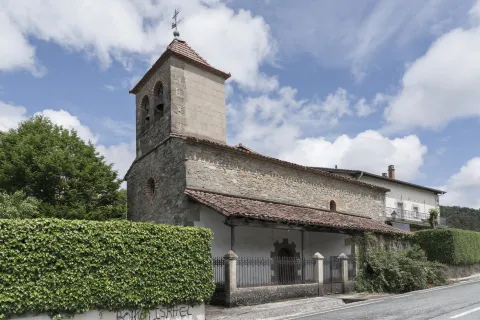
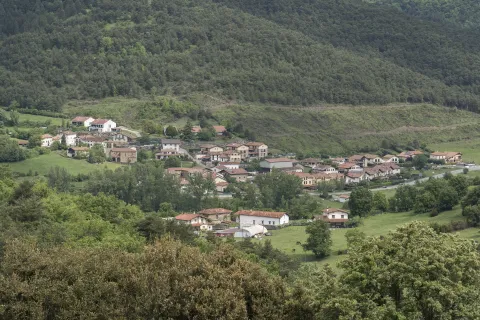
At an altitude of almost eight hundred metres, Errea nestles against the hillside as if seeking shelter in the mountain. From the left bank of the Arga, the hamlet gazes out over the valley with an ancient stillness. The Church of the Rosary, standing firm on its stone foundations, embodies the place’s mineral gravitas, whilst the names of long-abandoned settlements (Zuarraga and Sairas) survive in the whisper of the wind. Here, time does not move forward: it pauses. And in that pause coexist the memory of the councillors who governed in turn and the rural stone that still supports the walls of the present.
Errea is part of the Esteribar Valley and lies at an altitude of 793 metres. Surrounded by Ilárraz, Osteriz and Ardaiz, the village is historically organised around five manors that took turns governing the area. Here, the imprint of the ancient manors and the now-deserted settlements that shaped these mountains remains. Its municipal area, part of the Auñamendi region, is a territory where history blends with the landscape.
Exploring Errea is to delve into a landscape where faith and stone converse with the past.

Church of Errea (Pyrenees) with a two-arch bell tower and a curved tile roof, characteristic of northern Navarre.

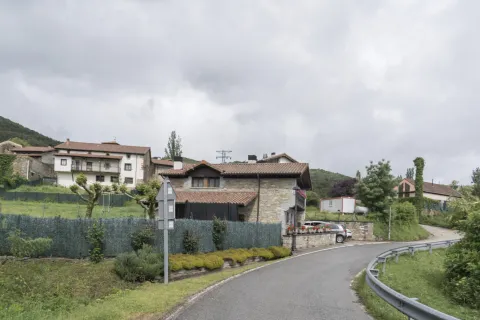
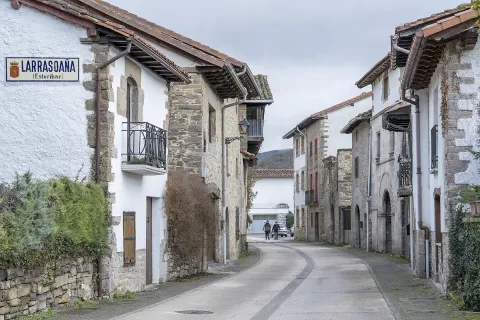
Traditional stone house with iron balconies in Errea, Navarre Pyrenees.

Stone wash house of Errea, surrounded by meadows and forest.
Resuelve las dudas más habituales sobre los diferentes parques y zonas naturales: cómo llegar, qué visitar, normas, rutas y servicios para planificar tu experiencia con facilidad.
Online
