
Agorreta
Where the mountain keeps the king’s word

Where the mountain keeps the king’s word
Here, the stone and the landscape tell stories not written in books but on the walls of the farmhouses and on the heights of Mendelarreta. Agorreta is a land where the memory of the royal domain beats in every block of ashlar and in the echo of ancient paths. The buttresses and stones, weathered by time, bear witness to the lives of the ‘collazos’, those villagers who paid their taxes under the authority of Sancho VI the Wise. The Fernandorena Palace stands as the guardian of a past that never ceases, where the daily life of the Esteribar Valley intertwines with centuries of history, and the journey to the pastures and forests of the Pre-Pyrenees becomes a ritual of contemplation.
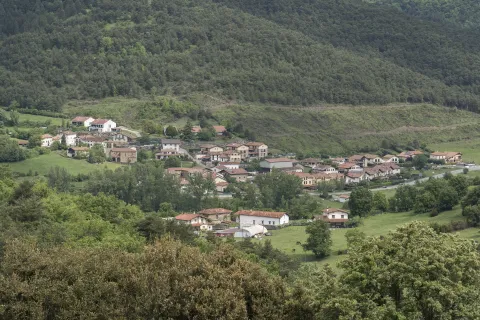
Agorreta lies at the heart of the Esteribar Valley. To the north, the heights of Mendelarreta and Etxarre frame the landscape, whilst to the east the Erro Valley opens up. Part of the Merindad of Sangüesa and the Auñamendi region, the village today harbours a history intertwined with the Crown since at least 1280, when twelve farming families paid their taxes in wages and sacks of oats. Nine houses of standard construction formed the original core of the hamlet, a structure that has been faithfully preserved over the centuries, like a thread linking generations under the same sky and the same stone.
Agorreta opens its doors like an ancient book written in ashlar and mountain whispers.

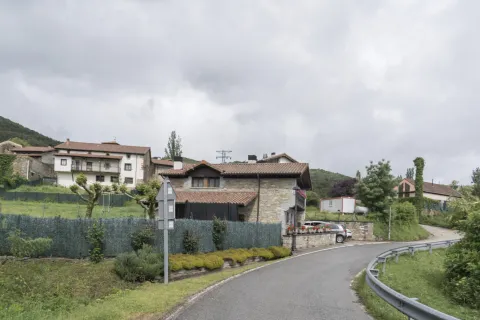
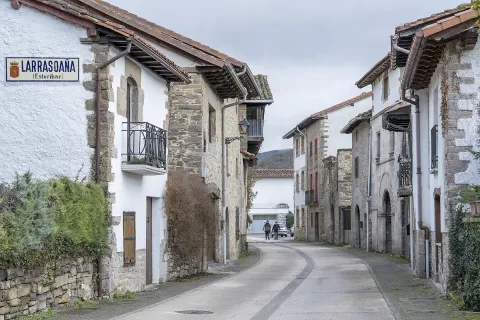
Traditional stone and wood farmhouse in Agorreta with wrought iron balconies and exposed wooden beams.

Agorreta church bell tower, surrounded by Pyrenean forest.

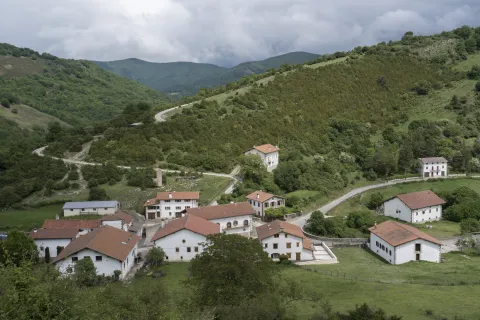
Complex of traditional stone buildings in Agorreta, Navarrese Pyrenees, with Pyrenean rural architecture and a forest in the background.
Resuelve las dudas más habituales sobre los diferentes parques y zonas naturales: cómo llegar, qué visitar, normas, rutas y servicios para planificar tu experiencia con facilidad.
From Pamplona, it is accessed via highways N-135 (via Valcarlos) or N-138 (via Urquiaga), traveling approximately 22.7 km to the town.
Online
