
Larraun
A landscape of grass, water and stone

A landscape of grass, water and stone
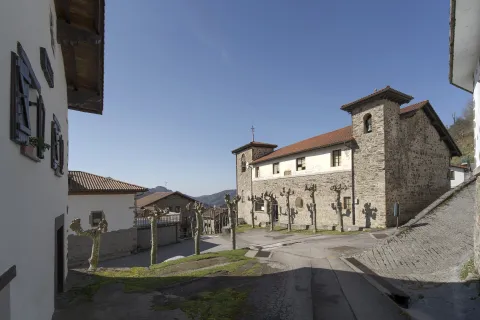
Where the Aralar mountain range unfolds its landscape across open meadows and dense forests, time seems to stand still: it settles. In Larraun, the landscape reveals itself in the rhythm of the water flowing through the streams and in the solidity of the farmhouses, which stand firm as living memories. This is a land where sound arises from the flow and the rest remains: a stillness that is not absence, but permanence, whilst mountain life unfolds slowly amongst beech woods and hidden watercourses.
This valley stretches across the north-west of Navarre, within the Norte de Aralar region, just over thirty kilometres from Pamplona. Larraun covers 107 km² traversed by the river that gives it its name, embraced by the slopes of the Aralar Natural Park. Its name, of Basque origin, directly evokes its essence: ‘place of pastures’, a definition that still breathes in every meadow today.
The recent history of the municipality is marked by its separation from Lekunberri in the 1990s, when Mugiro took on the role of administrative centre. As part of the Basque-speaking region, Larraun maintains a living connection with the Basque language and with traditional ways of life in the mountains, where daily life unfolds at an average altitude of 566 metres, striking a constant balance between culture and landscape.
In Larraun, the landscape and the human footprint converse in silence, leaving a trail that is discovered rather than visited.

Sunset over the Larraun Valley with limestone cliffs and forest.

Aerial view of the Larraun Valley with scattered houses, green meadows, and mountain forests in the background.

Aerial view of the Larraun Valley with scattered houses, green meadows, and mountain forests in the background.
Resuelve las dudas más habituales sobre los diferentes parques y zonas naturales: cómo llegar, qué visitar, normas, rutas y servicios para planificar tu experiencia con facilidad.
The source of the River Larraun is at the Iribas spring, a spot where water emerges directly from the rock in the foothills of Aralar.
According to the INE (2025), the population of Larraun was 918 inhabitants spread across its various settlements.
Larraun is not a single village, but a valley-municipality comprising various districts, situated in the Montaña de Navarra region, in its north-western corner, with its administrative centre in Mugiro.



Online
