
Areso
The village suspended between forest and history

The village suspended between forest and history
In Areso, the morning mist rises from the woods, and the mountains guard tales of resistance. Stone and the Basque language coexist as if time were held in their very breath. Here, the houses that survived the fire and the tranquillity of a land that is no longer a frontier reveal their essence without haste. It is a place of memory and contemplation, where the murmur of the centuries and the legacy of those who once inhabited these slopes are evident on every path and in every corner.
Areso serves as a natural bridge between Pamplona and Donostia-San Sebastián. Its history of autonomy and nobility is reflected in documents dating back to 1192 and in the coat of arms featuring a silver lion, established in 1770 following the definitive separation from Leitza.
The harshness of war and the capacity for reconstruction have shaped the history of Areso: in 1794, during the War of the Convention, French troops set fire to almost the entire town centre, with only the Peunea and Zubidi houses spared. Today, the town lies within the Basque-speaking region, where forests, rivers and its proximity to the border with Gipuzkoa give it a mountainous character.
Exploring Areso is like letting the mountains and the mist reveal their secrets.

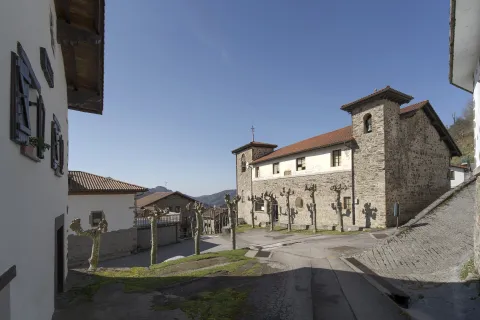
Traditional stone houses in Areso with balconies and mountains in the background under a clear sky.

Traditional stone houses and traditional architectural style next to a river in Areso, with a vegetable garden beside it.

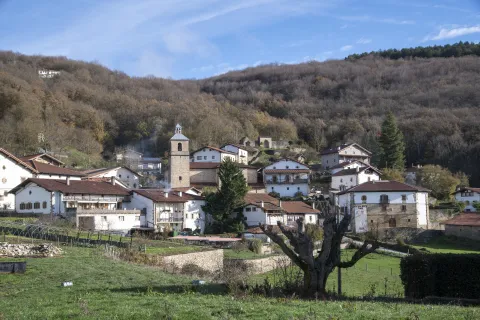
Traditional stone houses with a bell tower church in Areso, surrounded by wooded hills.
Resuelve las dudas más habituales sobre los diferentes parques y zonas naturales: cómo llegar, qué visitar, normas, rutas y servicios para planificar tu experiencia con facilidad.
Yes, local festivals and customs are still very much alive in Areso. One highlight is the tradition of placing the Olentzero in the square on Christmas Eve, a symbol of popular culture that remains intact.
Areso is located in the north-east of Navarre, in the district of Pamplona and on the border with Gipuzkoa, 49 km from Pamplona and 48 km from Donostia-San Sebastián.
The exact origin of the word ‘areso’ is unclear, but it may derive from ‘harea’ (sand) or ‘haritz’ (oak) with the suffix ‘-so’, although there is no definitive evidence.


Online
