
Imotz
Where the mist writes and the wood remembers

Where the mist writes and the wood remembers
In this place, time settles like moisture upon the oak. In Imotz, the atmosphere is hinted at in the distant echo of a train that no longer crosses the valley and in the steadfast presence of the farmhouses that stand firm, as if guarding something more than just stone. Here, the landscape presents itself as a space of slow passage, almost suspended, where the memory of ancient trades linked to wood and water coexists with the continuous whisper of the forest. Nothing bursts in: everything simply appears.
The Imotz valley lies in the north of Navarre, within the region of Ultzamaldea, some thirty kilometres from Pamplona. Its expanse forms a landscape where the forest and the scattered small settlements define a serene way of life, free from clamour.
For centuries, the oak forests of Imotz provided the essential raw material for shipbuilding, a link to the sea from the inland that remains inscribed on its coat of arms to this day. Today, the municipality forms part of the Basque-speaking region, maintaining a close relationship with the Basque language, traditions and harmony with the natural environment.
In Imotz, the landscape reveals itself, as if each element held a different layer of time.

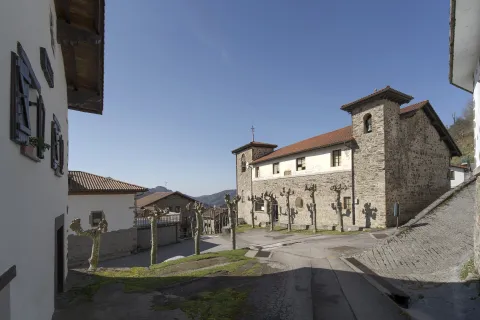
Traditional stone houses in Imoz, cobbled square with mountains in the background.

Traditional stone house in Imoz with a wooden balcony and a clay roof.

Group of traditional white and stone houses in Imoz, surrounded by meadows and mountain forests in autumn.
Resuelve las dudas más habituales sobre los diferentes parques y zonas naturales: cómo llegar, qué visitar, normas, rutas y servicios para planificar tu experiencia con facilidad.
Yes, the route passes through Imotz and can be explored on foot or by bike, allowing you to discover the valley by following the old railway line through a natural setting.
Imotz is situated in the north of Navarre, within the Ultzamaldea region, around 30 km from Pamplona, in a landscape of valleys and woodlands characteristic of the Pre-Pyrenean area.
According to the INE (2025), the municipality of Imotz has 433 inhabitants spread across its 8 districts.



Online
