
Leitza
Rivers of history and endless greenery

Rivers of history and endless greenery
Amidst the mist of the beech forests and the solidity of the bluish-grey stone, Leitza reveals itself as a network of streets and balconies that seem to whisper ancient stories. Every corner of the town reflects the passing of the centuries, from the ironworks that supplied fleets to the tunnels of the old txiki railway that now run through green paths. Here, the forests, the megalithic monuments and the urban stonework coexist as traces of different eras, shaping a landscape that preserves the valley’s memory intact.
Leitza lies in the north-west of Navarre, in the Cantabrian-Atlantic region, surrounded by mountains that form a horizon of peaks and beech forests, such as Eguzkizko Muinoa and Urepel. Its forests and rivers have witnessed over 6,000 years of history, from the megalithic remains to the charter shared with Areso in 1192. This border location made the town a strategic enclave for the Navarrese monarchy, marking a history of resistance and transformation.
After separating from Areso in 1770, Leitza knew how to adapt its resources and its people to the changing times. From the ironworks that forged iron for the fleets, to the arrival of the Plazaola railway and the consolidation of the paper industry in the 1960s, the town has learnt to embrace modernity without losing its roots. Today, as part of the Basque-speaking region, Leitza retains a landscape of stone and woodland that invites you to discover the history hidden in every corner.
Every corner of Leitza and its surroundings offers a window onto the past and the natural wealth of the Navarran mountains.

Aerial view of Leitza with the parish church with a dome in the foreground and red-roofed houses among mountains and meadows.

Aerial view of Leitza with red-roofed houses, surrounded by wooded mountains and green meadows.

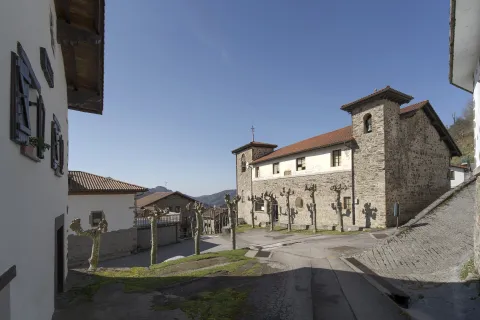
Stone bell tower with a dome in Leitza, surrounded by vegetation and a forest in the background.
Resuelve las dudas más habituales sobre los diferentes parques y zonas naturales: cómo llegar, qué visitar, normas, rutas y servicios para planificar tu experiencia con facilidad.
The patron saint of Leitza is Saint Tiburtzio (Saint Tiburtius). The festivities are held every 10 August with the txupinazo and reach their peak on 11 August, when the ezpatadantzaris perform the Ezpata-dantza in his honour.
Although there are no documents confirming the meaning of Leitza, it has been associated with the Basque word ‘leiza’, meaning ‘the chasm’, as well as with the Basque word ‘eleiza’, meaning ‘church’.
Leitza has a population of approximately 3,000.
Leitza is situated in the Leizarán Valley, within the Cantabrian-Atlantic region, bordering Larraun to the south and Malerreka to the east, but it has retained its own jurisdiction since separating from Areso in the 18th century.



Online
