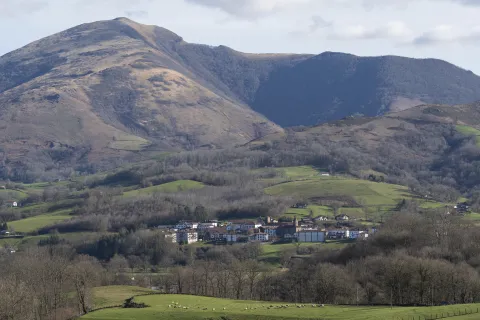
Vista general del pueblo de Amaiur, con conjunto de casas tradicionales y entorno montañoso del valle.

Amaiur

Stone, memory and silence

Under the gaze of Mount Gaztelu, time seems to have stood still in the stone and whitewash. Amaiur unfolds like a chronicle of Baztan architecture. After passing through the arch marking the entrance, the linear layout of its houses reveals the history of a place that has preserved its identity through the centuries. The ashlar palaces and farmhouses follow one another without rigidity, creating a space where history is not explained, but observed in the continuity of its walls.

Amaiur general information

The history of this place is unique. Amaiur maintained its independence as a municipality from 1665 until 1969, the year in which it was reintegrated into the Baztan Valley. This history has left its mark on an urban structure that stretches for half a kilometre, forming a street-village where the façades break up to offer different perspectives on life in the valley.

Before entering Amaiur, a 17th-century cross marks the boundary of the built-up area. Here, the absence of architectural monotony allows one to appreciate the diverse types of dwellings that have defined the landscape of our mountains for generations.

What to see in Amaiur?

In Amaiur, history is not explained; it remains. The castle ruins stand silently on the hilltop, recalling a time when this place was a frontier, a bastion of resistance and an endpoint.

  • Amaiur Castle and Monolith: On the summit of Mount Gaztelu lies the memory of what was the last bastion of the legitimate dynasty in the face of the 1512 conquest. In these lands, in 1522, the Navarrese resistance under the command of Jaime Vélaz de Medrano defended the site until its destruction. Today, the monolith and the archaeological excavations allow visitors to see the foundations of the fortress, offering a vantage point from which to contemplate the valley’s landscape.
  • Amaiur Mill: A living treasure that was already paying tribute to the Kingdom as far back as 1280. Inside, the millstones continue to grind maize in the traditional way, maintaining a practice that links the site’s heritage with the present day. It is a place where you can learn about the origins of the ‘talo’, a maize flatbread whose preparation is deeply rooted in our rural culture.
  • Palaces and civil architecture: Strolling down the main street is like walking through a gallery of nobility. Highlights include the Arretxea Palace (16th century), with its imposing façade; the Borda Palace, which attained the status of ‘cabo de armería’ in 1728; and the Arriada House, the historic building where meetings or ‘batzarres’ were held in the 16th century.  
  • Church of Our Lady of the Assumption: Located at the edge of the village, this medieval parish church, rebuilt in later centuries, preserves the spirit of a community that celebrates its patron saint’s festivities every 15 August. Surrounded by greenery rising towards Mount Gaztelu, the church marks the point where the village merges once more with the natural landscape of the hillside. 

Preguntas frecuentes

Resuelve las dudas más habituales sobre los diferentes parques y zonas naturales: cómo llegar, qué visitar, normas, rutas y servicios para planificar tu experiencia con facilidad.
chatbot

Living Stone

Online

18:19:09
Hello! How can I help you?