

Urbasa Range
A land where the forest becomes the horizon
Here, where the name whispers of the “water of the forest” and the plateau stretches out like a mantle of stone and beech woods, time slips away effortlessly. The Sierra de Urbasa bears the patient imprint of water carving through the limestone and the open silence of the open plains, where mares and Latxa sheep roam freely. It is a land of pause and listening, where dolmens emerge as memories and springs murmur an ancient story that unfolds slowly, allowing the essence of the mountains to surface without being named.
Urbasa Range general information
It is situated in western Navarre, forming a vast plateau that acts as a geomorphological and climatic boundary between Atlantic and Mediterranean influences. It covers 11,500 hectares of karst terrain, which has been part of the Urbasa and Andía Natural Park since 1997, a key area for understanding biodiversity.
Its landscape is characterised by a vast plateau at an average altitude of around 1,000 metres, mostly covered by one of the largest beech forests on the Iberian Peninsula. Its geology bears witness to the millennia-long work of water, which has carved caves, chasms and sinkholes into its rock, as well as feeding aquifers that emerge in springs of great visual impact. Daily life in the area remains linked to livestock farming and forestry, maintaining a balance between conservation and the traditional trades of pastoralism.
How to get to the Urbasa Range?
Access to the Sierra de Urbasa is straightforward via the roads connecting the region of Tierra Estella with La Barranca.
- Main route: It is crossed from north to south by the NA-718 road, which provides access from Olazagutía (north) or from Estella-Lizarra via the Urbasa Pass (south).
- Access points: You can enter via towns such as Zudaire, Baquedano or via the NA-120 road at Alto de Lizarraga.
- Geographical reference: It is located about 70 kilometres from Pamplona and 35 kilometres from Estella-Lizarra.
What to do in the Urbasa Range?
The landscape unfolds as a dialogue between water, stone and the memory of those who once lived there.
- Visiting the Balcón de Pilatos: A vantage point offering unobstructed views, situated atop an impressive rocky cirque with walls over 200 metres high, overlooking the Améscoas valley.
- Observing the source of the Urederra: A landscape where the water takes on turquoise hues in pools and waterfalls that spring directly from the limestone rock. Access is restricted and requires prior booking.
- Exploring the network of trails: The paths allow you to experience the essence of the forest through routes such as the Enchanted Beech Forest, the Shepherds’ Trail or the mountaineers’ route in Morterutxo.
- Megalithic sites: A place to explore the legacy of prehistoric civilisations through dolmens such as Artekosaro, probably the best-preserved in the mountain range.
- Caving: The rock formations feature unique caverns such as the Cristinos, Akuandi and Noriturri caves, which allow you to explore the park’s underground world.
Information about: Urbasa Range

Vertical limestone cliffs of the Sierra de Urbasa with a deciduous forest in autumn under a cloudy sky.

Bird of prey in flight over limestone cliffs of the Sierra de Urbasa.

Limestone cliffs emerging among an autumn beech-fir forest in Sierra de Urbasa with ocher, orange, and green colors in seasonal transition.
-

Peña Izaga
Peña Izaga rises above the Izagaondoa valleys as a broad and serene mountain, where the landscape se… -

Higa de Monreal
The Higa de Monreal rises above the Navarran landscape with a pyramidal silhouette that seems to eme… -

Sierra de Leyre
Here, where the mountain rises like an ancient wall guarding the entrance to the Pyrenean valleys, t… -
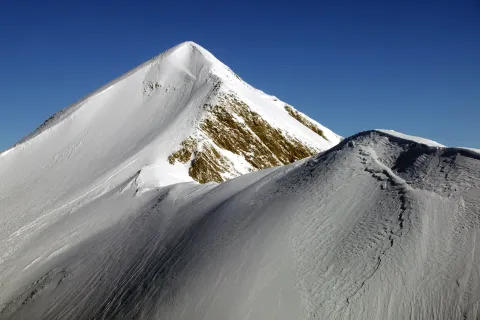
Orhi Peak
Here, where the ridge breaks through the two-thousand-metre barrier and the summit wind dominates th…
