

Common symbols: Eguzkilore
Tradition and protection in the form of a flower
In Navarre, certain symbols have been part of everyday life for centuries. The Eguzkilore is one of them: a flower associated with the protection of the home, popular beliefs and the relationship between people and nature. Its presence on doors and façades still adorns many houses in the valleys and villages of Navarre, keeping alive a tradition passed down from generation to generation.
Beyond its appearance, the Eguzkilore retains a strong symbolic value. The shape of its leaves, its association with light and the legends surrounding it have made this plant one of the most recognisable elements of Basque and Navarrese popular culture.
What is the Eguzkilore?
The Eguzkilore is one of the most recognisable symbols of Basque and Navarrese culture. Its name means “sunflower” in Basque and refers to the shape of this plant, whose golden centre resembles the image of the sun. It comes from Carlina acaulis, a species that grows in mountainous areas and is notable for its spiny leaves and characteristic silvery-toned flower.
For centuries, the Eguzkilore has been linked to the protection of the home. Traditionally, it was gathered and dried to be placed on the doors of houses, stables and barns, in the belief that it warded off evil spirits, storms and bad omens. Its presence can still be seen on many façades in the north of the Iberian Peninsula, especially in rural areas where the tradition continues to form part of everyday life.
The origin of the Eguzkilore
Its origin is deeply rooted in Basque mythology. According to popular legends, Amalur —Mother Earth— gave this flower to human beings to protect them from the creatures of the night, such as the sorginak (witches) or the gauekoak (night spirits). The shape of the Eguzkilore symbolised sunlight and led these beings to believe that the day was not yet over, preventing them from approaching homes.
Beyond the legend, the Eguzkilore represents the connection between nature, popular beliefs and cultural identity. Over time, its meaning has evolved and today it is also interpreted as a symbol of hope, resilience and a deep-rooted connection to traditions. Many people keep it in their homes not only for its decorative value, but also as a way of keeping the memory of their ancestors alive and maintaining a link with Basque culture.
Today, the Eguzkilore continues to occupy a prominent place within the traditional Basque-Navarrese imagination. It features in crafts, jewellery, decoration and popular celebrations, keeping intact thatidea of light and protection that has accompanied it for generations.
Información sobre: Common symbols: Eguzkilore

Street with stone houses in Ardaitz, Navarrese Pyrenees, with an eguzkilore on the doorway.

Detail of a dried eguzkilore above a red door in Garaioa, with wrought iron ornamentation.

Floral detail sculpted in stone in Longuida, featuring an eguzkilore motif.
-
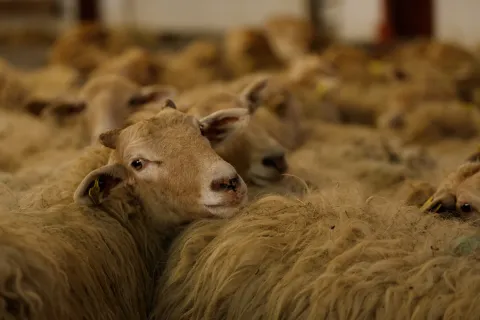
Sheep Shearing Day
With the aim of preserving and promoting one of Navarre's most traditional livestock farming practic… -
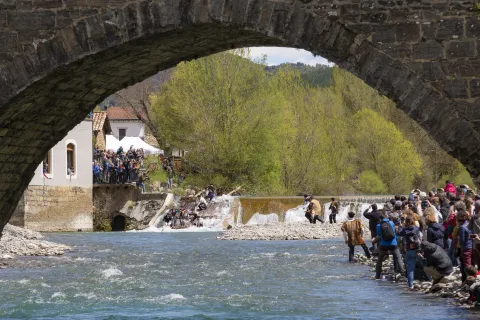
Raft Day
In honor and remembrance of the raftsmen of the Roncal, Salazar, and Aezkoa valleys, "Raft Day" was … -
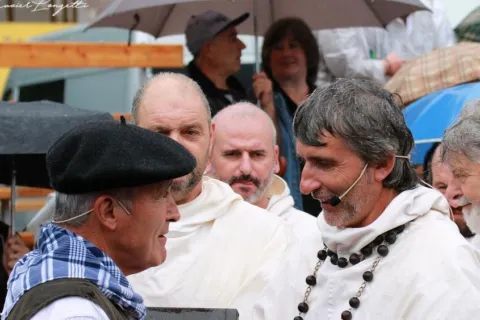
Iron Day
Here, where the valley paths linked the inland ironworks with the Cantabrian Sea, Urdazubi/Urdax kee… -
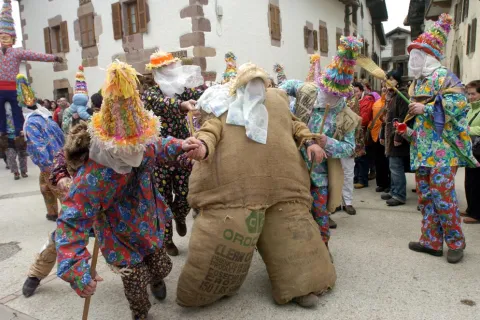
Traditional Carnivals
Celebrations that connect with the heritage of NavarreHere, where winter is still felt amidst the mo…
