

River Bidasoa
The Atlantic pulse of a border river
Here, where the river’s course preserves the memory of ancient paths and the water flows through the Atlantic mountains until it meets the Cantabrian Sea, time dissolves in every backwater. The River Bidasoa is home to the patient return of the salmon and the whisper of the marshes where birds stop to rest. It is a land of transit and borders, where the rainforest and the traces of ancient Oiasso intertwine in a serene harmony that reveals itself unhurriedly to those who walk along its banks.
Bidasoa River general information
It serves as a backbone of the north of the peninsula, stretching between 66 and 69 kilometres and guarding the passage between the Pyrenean mountains and the Cantabrian Sea. Its identity is rooted in a 710 km² catchment area, whose mineral and plant matter undergoes a constant transition from its source in Navarre to its border estuary. In its upper reaches, up to the town of Oronoz-Mugaire, it is known as the Baztán River, and it definitively becomes the Bidasoa as it enters the Bertizarana Valley.
It is characterised by a landscape that narrows after receiving the waters of the Ezkurra stream at Doneztebe/Santesteban, flowing through steep valleys where the limestone and alluvial deposits have formed historic terraces. Daily life on its banks has been linked for centuries to the use of its waters as a transport route and fishing resource, maintaining a balance today where unique wildlife, such as the European mink and the otter, coexists with urban settlements.
How to get to the River Bidasoa?
Access to the River Bidasoa is straightforward via the roads that criss-cross the valleys of north-western Navarre and the coast of Gipuzkoa:
- Navarre section: The main access is via the N-121-A road, which runs alongside much of the river’s middle and lower reaches, allowing you to observe the flow from Oronoz-Mugaire to Endarlatsa.
- Mouth area: The final stretch of the river is accessible from the towns of Irún and Hondarribia in Gipuzkoa, or from Hendaye in France, points where the river widens before flowing into the sea.
- Greenway: A space for leisurely exploration is the Greenway, which uses the old railway line to connect Oieregi with Behobia along a 42-kilometre route accessible to pedestrians and cyclists.
What to do on the River Bidasoa?
Along its banks, the experience unfolds amidst water, woodland and history.
- Exploring the Bidasoa Greenway: A route for taking in the Atlantic landscape via a flat path linking villages such as Sunbilla , Doneztebe and Lesaka , ideal for forest observation and cycle tourism.
- Boating and sightseeing: A place to take in the landscape from the water through boat trips or leisurely kayaking and canoeing on the calmest stretches.
- Fishing culture: A record of a millennia-old tradition in the catch-and-release of trout and salmon, particularly in the regulated reserves along the Navarran stretch.
- Birdwatching: An area of great ornithological value in the Txingudi Marshes and the Plaiaundi Ecological Park, where you can observe migratory birds resting on their journey between northern Europe and Africa.
- Historical trail: A place to explore the history of the border on Pheasant Island — the world’s smallest condominium — or to follow the Roman trail of the city of Oiasso in Irún.
- Riverbank hiking: The riverbanks offer local routes, such as the Sunbilla circular walk or the path to the Bisusta waterfall.
Information about: River Bidasoa

Señorío de Bertiz Natural Park | Bidasoa River

Bidasoa River in Baztan Bidasoa with riparian forest, rocks, and branches hanging over calm waters.

Bidasoa River flanked by deciduous forest and forested mountains in the Baztan-Bidasoa valley.
-
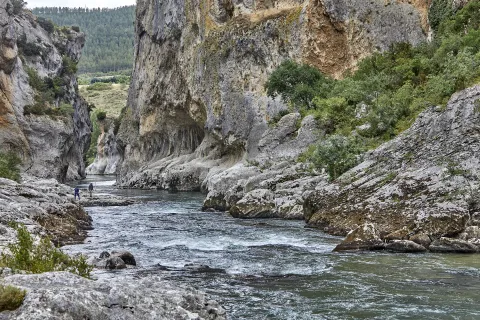
The Irati River
Here, where its name recalls the old log drives to the sawmills and its waters now flow between the … -
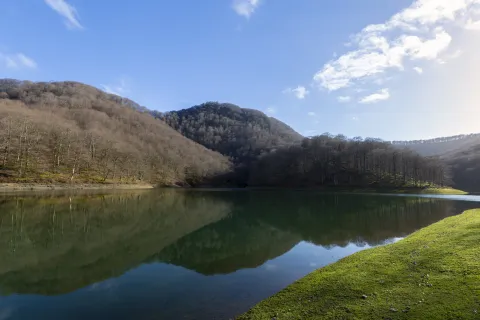
Leurtza Reservoir
Here, where two bodies of water lie hidden amidst the mist and the deep green of Malerreka, time dis… -
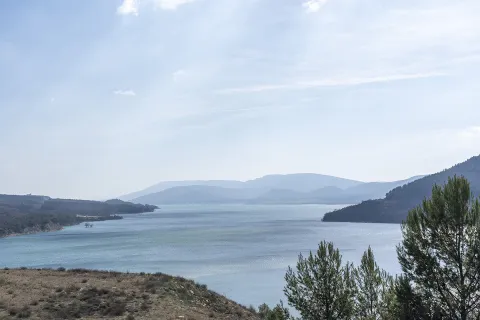
Yesa Reservoir
At the Yesa Reservoir, water does not merely occupy space: it transforms it. The River Aragón widens…
