

The Irati River
Where the water holds the forest’s memory
Here, where its name recalls the old log drives to the sawmills and its waters now flow between the Irati Forest and its confluence with the River Aragón, time flows unhindered. The atmosphere of the River Irati is imbued with the force of the spring thaw that awakens every year and the memory of the power stations that still stand guard on its banks, where the constant murmur of the water sets the rhythm of life along the riverbank. It is a land of movement and memory, where the forest and the mountains are reflected in its waters, allowing the essence of the Pyrenees to reveal itself at every turn.
Irati River general information
The River Irati is one of the most abundant headwater rivers in Navarre, with a total length of 88 kilometres that marks the transition between the high mountains and the pre-Pyrenean gorges. It flows through a catchment area of 1,620 km² which has historically served as an industrial and energy powerhouse through mills, ironworks, sawmills and paper mills.
Over time, its course has undergone significant changes due to hydroelectric development, notably the construction of the Irabia and Itoiz reservoirs, which have determined the flow rate of the river. Currently, the river is protected under European legislation as a Site of Community Importance (SCI), ensuring the conservation of the riparian vegetation and the rich fish stocks in a high-quality state.
How to get to the River Irati?
Access to the Irati River is straightforward via the various valleys it flows through from its source to its mouth.
- Headwaters and upper reaches: Aezkoa Valley : The river can be accessed via the towns of Aribe, Garralda or Garaioa, where the terrain allows for a direct view of the river from the town centres.
- Middle section: It flows through Oroz-Betelu and Olaldea, areas where my industrial legacy is most evident in the old buildings.
- Lower section: Its final stretch can be seen in the vicinity of Sangüesa and Liédena, just before it joins the River Aragón.
What to do on the River Irati?
The river’s course invites you to discover the connection between the memory of ancient trades and the life that flows along each bank.
- Riverbank hiking: A space to take in the landscape via the network of signposted trails linking towns such as Garralda, Aribe and Garaioa, allowing you to immerse yourself in the surroundings of oak and beech forests.
- Recreational fishing: A record of numerous fishing reserves, both catch-and-release and non-catch-and-release, thanks to the excellent conservation of the trout population.
- Industrial heritage: A region where you can discover the legacy of the Irati S.A. company through the abundance of pipes, weirs, canals and power stations that still bear witness to the quality of these historic structures.
- Recreational use: During the summer, daily life in the area shifts to the riverbanks, where people come to swim and enjoy nature at a leisurely pace in the backwaters.
- Birdwatching and landscape: In the final stretch, the rock has carved out the impressive Foz de Lumbier gorge, a prime spot for watching birds of prey soaring over the river.
Information about: The Irati River

Aezkoa Valley | Irati River

Rafting down the Irati River

Autumnal beech forest of the Irati Forest with golden and green tones, river in the foreground and clear sky.
-
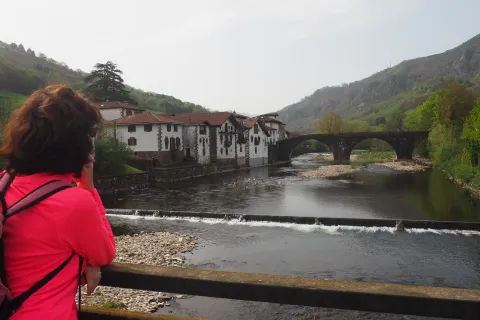
River Bidasoa
Here, where the river’s course preserves the memory of ancient paths and the water flows through the… -
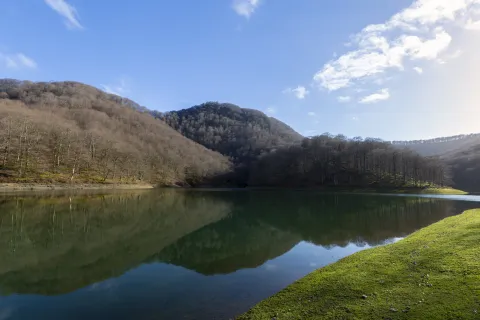
Leurtza Reservoir
Here, where two bodies of water lie hidden amidst the mist and the deep green of Malerreka, time dis… -
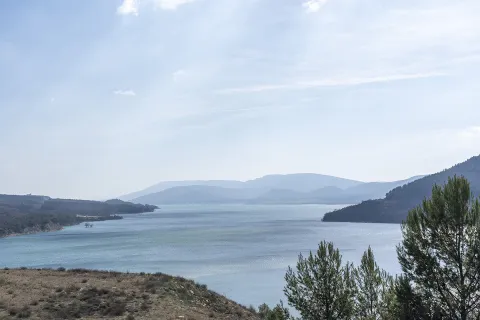
Yesa Reservoir
At the Yesa Reservoir, water does not merely occupy space: it transforms it. The River Aragón widens…
