

Malloas Cable Observatory
Where the air echoes the passage of labour
Here, where the air still seems to hold the whisper of descending loads and the limestone ridges of the Malloas cast their shadow over the Araitz valley, time simply unfolds. At the Malloas Cable Observatory, one can sense the echo of shepherding and the silence of the ridges that were once linked to the farmsteads by taut steel cables. It is a place of observation and memory, where the warmth of the wood and the mark of a unique craft coexist in a leisurely harmony, allowing the identity of the land and the pulse of daily life to emerge unhurriedly.
Malloas Cable Observatory – general information
It is registered as a small interpretation centre and viewpoint, an open structure that preserves the history of aerial grass transport in the Araitz Valley. Its identity is rooted in the Zezelain landscape, housed in an eco-friendly building constructed using traditional and natural materials such as wood.
Its history covers a pivotal period between 1920 and 1970, when the need to feed the livestock led to the installation of a network of cables —zip lines— to bring fodder down from the high pastures of the Malloas. Inside, the exhibition is organised into five interpretive panels with short texts and QR codes that allow visitors to explore the biodiversity of the area, traditional ways of life, grazing practices and the workings of this technical innovation. It forms part of a project to promote ethnographic heritage managed by Araitz Town Council and the Araizko Zaporeak association.
How to get to the Malloas Cable Observatory?
The journey up to the site is a leisurely one along a path that starts from the centre of Gaintza.
- Starting point: The route begins in the square in the village of Gaintza.
- Route: The ascent follows a 1.5-kilometre concrete track, climbing 150 metres in elevation until reaching the Zezelain area.
- Location: It is situated approximately one kilometre above the town centre of Gaintza, at the very spot where one of the old cables has been recovered.
What to do at the Malloas Cable Observatory?
This site reveals the connection between the memory of the countryside and the verticality of the Aralar landscape.
- Experiencing the viewpoint: A space for independent observation of the Malloas, allowing visitors to appreciate the fragility of the ecosystems and the power of the karst landscape.
- Interpreting the past: A space to discover, through information panels and digital resources, traditional land uses such as the lime kiln, the tile-making site and the old paths.
- Kablearen Eguna (Cable Day): Every September, daily life is transformed to recreate the manual cutting of grass with a scythe and its transport by cable.
- Birdwatching: The terrain is home to a colony of vultures, whose activity can be observed from this vantage point.
- Immersion in local culture: A space where the Basque language is recognised as the heart of communication and the valley’s identity.
Información sobre: Malloas Cable Observatory

Historical aerial cableway demonstration at the Cable de las Malloas Observatory, Gaintza, with operators manipulating traditional machinery.

Interpretation center and observatory of the Cable de las Malloas in the Araitz valley, a modern wooden structure with a red tile roof.

Aerial cableway of the Cable de las Malloas Observatory in Gaintza, with mountains in the background.
-
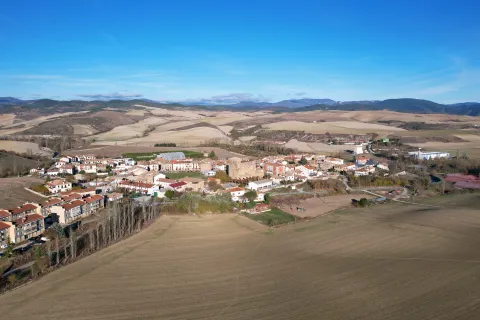
The farmhouses
Here, where stone and wood come together to sustain centuries of quiet life, time settles beneath sl… -
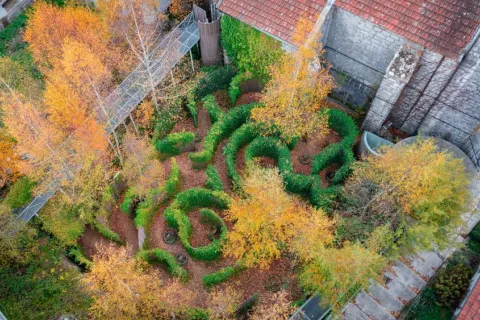
Museum of Funerary Stelae
Here, where stone steles rise like circles facing the sun and the earth holds the names of the homes… -
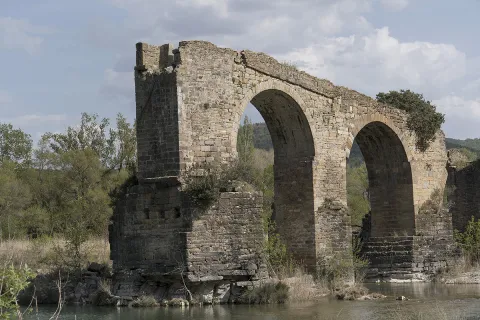
Roncaleses Bridge
Here, where stone bears the memory of passage and the River Aragón flows beneath arches that are no … -
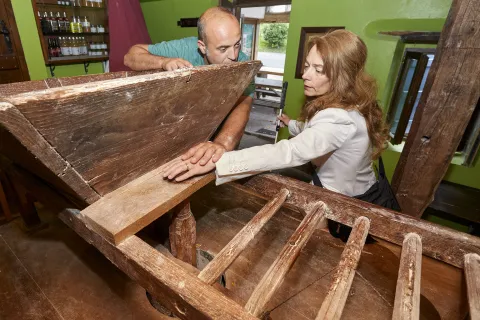
Amaiur Mill
At the entrance to Amaiur , the mill emerges as a discreet yet constant presence, linked to the soun…
