
Ochagavía / Otsagabia
The pulse of the water and the shape of time

The pulse of the water and the shape of time
Here, at the point where the Zatoia and the Anduña intertwine to give life to the River Salazar, stone and mist weave a story that does not impose itself, but simply unfolds. In Ochagavía, the atmosphere is felt in the solidity of the doorways and the precise slope of the roofs that withstand the snow, as if every house knew its exact place in winter. It is a land of lived-in tranquillity, where the sound of water and the layout of the etxekartes accompany a life that moves slowly, allowing the mountains to express themselves without interruption.
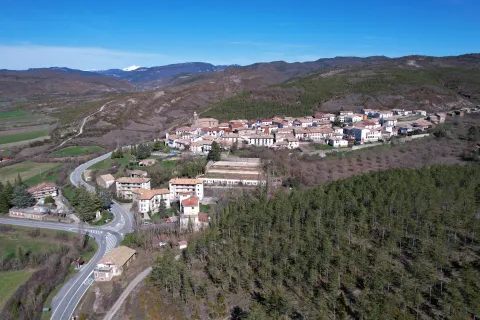
Ochagavía stands at an altitude of 764 metres, acting as the heart and gateway to the Salazar Valley . Its identity has been shaped by ancient privileges and profound losses: from the collective nobility of the 15th century to the devastation of the 1794 fire, which forced the hamlet to be rebuilt almost from the ashes. Administratively, it belongs to the mixed zone, where the Salacenco Basque language — today little more than a documentary echo — left its mark on daily life for centuries. The economy, rooted in transhumance and the use of the forest, now coexists with tourism that blends in unobtrusively, respecting the balance of an environment watched over by the nearby Irati Forest .
In Ochagavía, every corner reveals a dialogue between the architecture, the river and the passage of time.

Stone bridge over a snowy river in Ochagavía, with white houses and a forest in the background.

Stone bridge over a snowy river in Ochagavía, with white houses and a forest in the background.

Snowy bridge and traditional white houses of Ochagavía with a forest in the background.
Resuelve las dudas más habituales sobre los diferentes parques y zonas naturales: cómo llegar, qué visitar, normas, rutas y servicios para planificar tu experiencia con facilidad.
Ochagavía is recognized as one of the most picturesque villages in the Pyrenees, having been chosen in 2016 as one of Spain's 7 rural wonders for its combination of architecture, history, and the natural environment of the Irati Forest.


Online
