
Esparza de Salazar / Espartza Zaraitzu
Where snow sculpts the stone and the valley breathes slowly

Where snow sculpts the stone and the valley breathes slowly
Here, in the stretch where the River Salazar flows most serenely, the stone and the winter weave a story that needs no telling. In Esparza de Salazar, the atmosphere is felt in the density of the silence, in the ancient presence of the large stone doorways and in the shadow of tales that still linger amongst the houses. It is a land where the cold defines the character and where landscapes shaped by erosion bear witness to a time that unfolds unhurriedly.
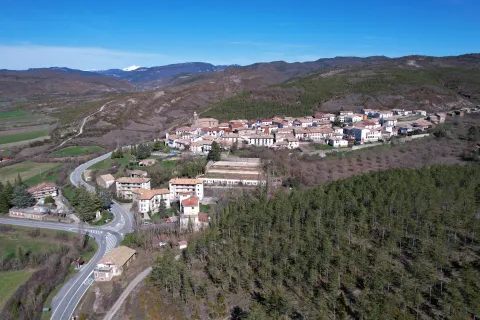
Esparza lies at an altitude of 697 metres, occupying a central position within the Salazar Valley ( ) . Its identity is shaped by a vast territory of nearly 27 km², where the climate oscillates between Atlantic and Mediterranean influences, giving rise to a mosaic of pine, beech and oak forests. For centuries, Esparza formed part of the valley’s administrative district, until in the 15th century it was granted collective nobility, consolidating its status as a community in its own right, and in the 19th century it was established as an independent municipality . Today, with a population of around 75, life maintains a balance between tradition and adaptation. Its past as a centre for livestock and wool production has given way to new forms of activity, where tourism and nature coexist with a heritage that remains present in every corner. Known for its harsh winters, the village retains a character shaped by the snow and its proximity to sites such as the Selva de Irati and the Abodi mountain range .
Esparza’s heritage unfolds as a dialogue between stone, history and the landscape.

White houses with red roofs by the river in Esparza de Salazar, with a church and forested mountain in the background.

Stone bridge and traditional architecture in Esparza de Salazar, a Pyrenean village with red-roofed houses and a forest in the background.

Buildings with orange tiles by the river in Esparza de Salazar, surrounded by mountain forest and vegetation.
Resuelve las dudas más habituales sobre los diferentes parques y zonas naturales: cómo llegar, qué visitar, normas, rutas y servicios para planificar tu experiencia con facilidad.
It is located in the northeast of Navarra, occupying the central area of the Salazar Valley, about 78 kilometers from Pamplona and at the doorstep of the Irati Forest.
Esparza celebrates its patron saint festivals, known as Txerriki Bestak, on the first weekend of August. It also honors its patron saint, Saint Andrew, on November 30.


Online
