

A stone threshold to the town
On the banks of the River Arga, Olloki draws its strength from the flow of its waters and its mineral heritage, bearing witness to a lineage that upheld privileges and loyalties from the 13th century onwards. The village breathes to two rhythms. On one side, the hamlet that retains the gravitas of the past; on the other, the residential expansion that has transformed its demographic pulse within the Esteribar valley . The church of San Adrián, with its medieval roots, contemplates this silent transition between the mountains and the proximity of Pamplona.
Here, the traces of the families of Agramonte are not on display: they seep into the daily routine, into the place names, into the way the stone catches the light. Olloki allows the past to coexist with the present, like someone who accepts the passage of time without renouncing their origins.
Olloki – General Information
Olloki forms part of the municipality of Esteribar, just 8 kilometres from Pamplona, and is currently the most populous town in the valley, ahead of Zubiri, the administrative capital. Its recent history reveals a profound transformation: from a former council (disbanded in 2005 by a local decision) to an established residential and technical enclave, driven in part by the development of the Ollokilandia-Urbi industrial estate. This evolution has not erased its identity, but has shifted it towards a new balance between tradition and growth.
In Olloki, Basque and Spanish coexist as official languages, reflecting the borderland character of a place that acts as a hinge between the serenity of the Pyrenees and the urban dynamism of the basin.
What to see in Olloki?
Amidst coats of arms and riverside paths, Olloki allows its history to unfold without artifice.
- lloki Palace: Former residence of the lloki family , an Agramont lineage linked to the attempts to restore the Kingdom of Navarre in the 16th century. Its ashlar masonry recalls the town’s strategic importance as a transit point towards the Pyrenees.
- Church of San Adrián: A Romanesque church (12th century), altered in the 18th century, which dominates the upper part of the town centre. Inside, Gothic paintings dedicated to Saint Agatha are preserved, rediscovered following the restoration of the altarpiece.
- Traditional town centre and residential area: A stroll reveals the contrast between the historic quarter (coats of arms, ashlar walls, narrow streets) and the modern expansion. This juxtaposition of eras explains the growth of a settlement that has successfully integrated new ways of life without diluting its roots.
- The Arga River area and Eremua trails: In the southern part of the valley, pine forests and meadows line the river’s course before it enters the Pamplona basin. The Eremua MTB-Trail area offers mountain biking and hiking trails that allow visitors to appreciate the terrain and the changing landscape.
- Ollokilandia-Urbi Industrial Estate: An area designated for high value-added industries that reflects the current economic dynamism, integrating technology and productive activity into the traditional environment.

Rural stone church with a bell tower in Olloqui, next to a viewpoint.

Village and palace of Olloki seen from a viewpoint with a stone wall and ivy in the foreground.

Stone church with an arch in Olloqui, Navarrese Pyrenees, with an entrance path and a well-maintained garden.
Preguntas frecuentes
Resuelve las dudas más habituales sobre los diferentes parques y zonas naturales: cómo llegar, qué visitar, normas, rutas y servicios para planificar tu experiencia con facilidad.
How many inhabitants does Olloki have?
In Basque, there is the word "oloki," which can refer to a wooden board or bench in some dialectal contexts, although it is not a very common term.
Olloki's patron saint festivities are celebrated in honor of Saint Adrian, the patron saint of the parish church. Additionally, every four years, Olloki hosts the Esteribar Valley Day during the second weekend of June, in rotation with other localities.
You might also be interested in
-
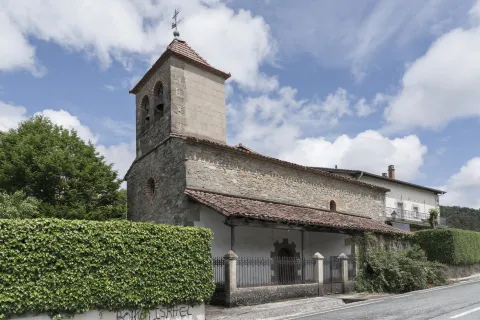
Agorreta
Here, the stone and the landscape tell stories not written in books but on the walls of the farmhous… -
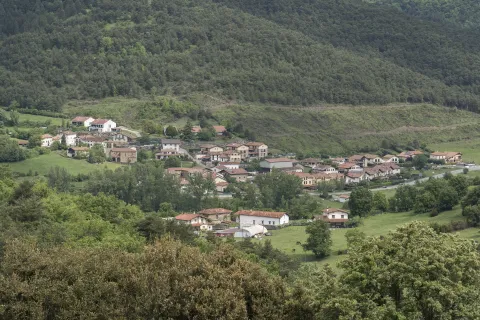
Urdaitz/Urdániz
On the right bank of the Arga, time is not measured in calendars but in traces: those left by water … -
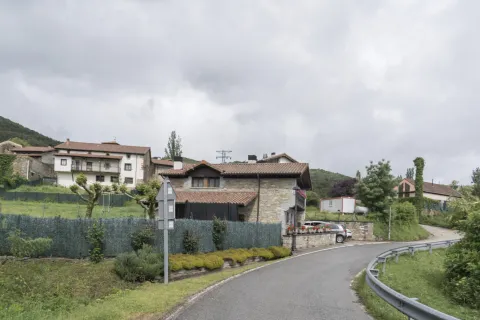
Sarasibar
Sarasibar lies on the right bank of the River Arga, as if aware of its lineage. -
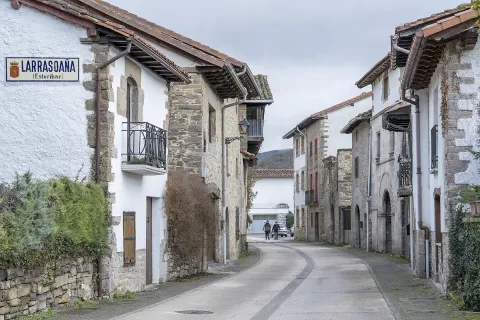
Larrasoaña
Larrasoaña does not spread out: it stretches out.
AltaNavarra Chat
Online
