
Antxoriz
Seven houses and a story of grandeur

Seven houses and a story of grandeur
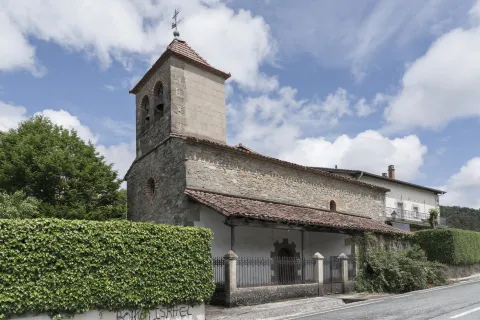
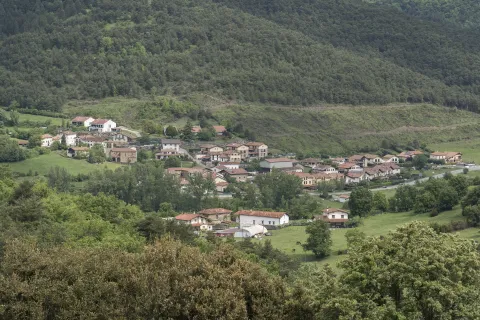
Antxoriz stands out against the sky like a stone statement. Seven original houses were enough to found a place where nobility was not ostentation, but a deep-rooted tradition. Here, the stonework speaks softly and the crags hold history as if they were pages open to the wind.
Antxoriz was born in the wake of manors and deaneries, linked to ancient institutions that governed the territory with a spiritual vision and a human touch. Between the riverbed and the heights of the Auñamendi region, the village unfolds like an intimate frontier: neither quite water nor quite mountain. The medieval essence remains in its walls, whilst the relief of the southern valley traces a landscape that seems to have been written rather than inhabited.
Antxoriz rises to an altitude of 531 metres in the southern part of the Esteribar Valley. Its inhabitants are custodians of an entirely private territory, with no communal land: a singularity that defines their relationship with the land.
As early as the 11th century, it was linked to powerful religious institutions such as the Abbey of Leire and, later, Santa María de Roncesvalles. For centuries, the administration of the council was organised on a rotational basis amongst the leading families, as if each façade took on, in turn, the responsibility of sustaining the community. Antxoriz is not large in size, but it is rich in history: every metre contains a distinct layer of memory.
In this corner of the valley, what is visible is merely the threshold of its history.

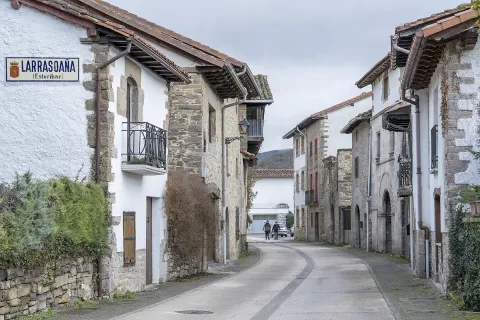
Street in Antxoriz, Navarrese Pyrenees, with stone houses and mountains in the background.

Traditional architecture of Antxoriz in the Pyrenees, with a white facade, red wooden shutters, and stone walls.

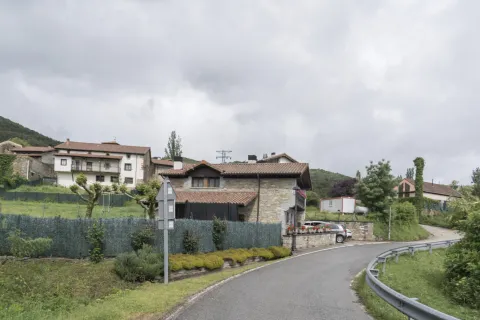
Stone rural house in Antxoriz, Navarrese Pyrenees, with a garden and forested mountains in the background.
Resuelve las dudas más habituales sobre los diferentes parques y zonas naturales: cómo llegar, qué visitar, normas, rutas y servicios para planificar tu experiencia con facilidad.
Antxoriz is located in the southern part of the Esteribar Valley (Navarre), on the right bank of the Arga River, 11.5 kilometers from Pamplona.
The patron saint festivities are celebrated annually on December 8th in honor of the Immaculate Conception, patroness of our parish.
Online
