

Ugarrón Gorge
The silent stone chasm above the bed of the River Areta
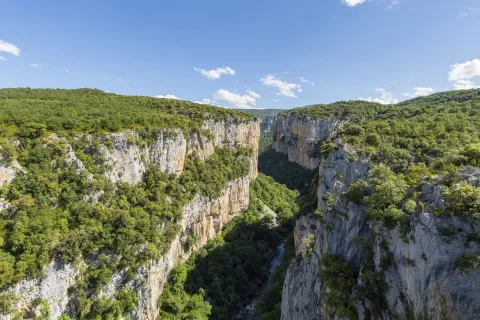
Here, where the waters of the River Areta carve through the limestone and the walls of El Cubillar cast a shadow over the vultures, time flows like the river itself. In the Foz de Ugarrón, the sturdiness of the kermes oak woodland coexists with the silence of the ancient pastoral stones, revealing a subtle transition between the Mediterranean vegetation and the pre-Pyrenean ravines. It is a cleft of water and vegetation, where the austerity of the scrubland and the life of the valleys manifest themselves in serene harmony.
Foz de Ugarrón – general information
The Foz de Ugarrón is a gorge carved out by the River Areta in the pre-Pyrenean mountain ranges of Navarre, within the municipalities of Romanzado, Urraúl Alto and Urraúl Bajo. Designated a Natural Enclave in 1989 (and extended in 1997), it forms part of the Sierra de Ugarra Special Area of Conservation (SAC). The river has carved this gorge through limestone and sandstone, creating rocky cliffs flanked by kermes oak forests and Mediterranean scrub featuring species such as boxwood, privet, cornicabra olive, juniper and gall oak.
Its cliffs and forests provide a refuge for remarkable wildlife, including birds such as the griffon vulture and the peregrine falcon, as well as riverine species such as the otter and the Pyrenean desman. Furthermore, the area is home to a significant cultural heritage, including the Idokorri-Ugarra dolmen site (featuring the Aikoa and Ugarra dolmens), the ruins of the abandoned village of Aikoa and the route of the ancient Cañada Real de los Salacencos.
How do you get to the Foz de Ugarrón?
One of the main access points is at the hamlet of Casas de Berroya, in the municipality of Romanzado. From Lumbier, take the NA-178 towards Navascués and then the turn-off towards Arboniés. The route continues through Murillo-Berroya until you cross the bridge over the River Areta.
Next to the chapel of San Andrés and the Berroya spring, there is a car park where you can leave your car and start the walk.
You can also access the gorge from its northern end, setting off from Imirizaldu, in Urraúl Alto. From there, take the road bridge towards Adoain, which crosses the River Areta; there is a small car park next to the riverbank.
What to do at the Ugarrón Gorge?
The gorge offers the chance to combine walking, wildlife watching and exploring the local heritage:
- Walk the gorge trail: follow the route, which is approximately 7.5 to 9 kilometres there and back, between Casas de Berroya and the northern section of the gorge. The trail winds through the hillsides amongst box trees, kermes oaks and holm oaks, and features sections marked by stone cairns.
- Birdwatching and rock formations: keep an eye on the cliffs and the sky to spot griffon vultures and peregrine falcons, as well as admiring the rock formations around El Cubillar.
- Exploring the River Areta: walk along the riverbank in the southern part of the gorge to discover the riverside vegetation and enjoy the riverside scenery.
- Explore the local heritage: visit the San Andrés chapel in Berroya, or round off your visit with a trip to the Santa Fe chapel in Urraúl Alto, where a 15th-century granary is still standing.
Information about: Ugarrón Gorge

fozdeugarron-berroya

Foz-ugarron-romanzado

LAGRAN OLA-UGARRON
-

Foz of Lumbier
In the Foz de Lumbier, the Irati River has carved its way through the rock for centuries, whilst bir… -
Foz of Arbaiun
Here, where the rock rises in a vertical wall reaching almost four hundred metres and the River Sala…
