

Santa Criz Archaeological Site
Where the ancient city still breathes
Here, where the ashlar of the ancient buildings preserves the memory of the Basque region and the landscape of the Val de Aibar opens out towards the distant Pyrenees, time seems to pass without haste. In the hills of Santa Criz de Eslava, the atmosphere is defined by the dialogue between the archaeological stone and the living matter of the surrounding vineyard. It is a land of contemplation and mineral calm, where the identity of the ancient civitas and the daily pulse of the earth coexist in serene harmony, allowing history and rural life to unfold gently.
Santa Criz de Eslava general information
It is recognised as the most monumental archaeological site in Navarre and one of the most impressive Roman cities in the north of the Iberian Peninsula. It is situated on a strategic hill between the Izco and Zaldinaga mountain ranges, commanding the pass between the Ebro Valley and the mountains.
Its chronology records an initial occupation as a Basque-style hill fort around the 5th or 4th century BC, later transforming into a Roman city that reached its peak between the 1st and 2nd centuries AD. Although its original name remains shrouded in speculation, such as Nemanturista or Biturís, its archaeological remains preserve key features such as an imperial forum with a cryptoporticus and an extensive civic necropolis, reflecting the political and social significance it held in antiquity.
How to get to Santa Criz de Eslava?
Access to the site is straightforward via the central-eastern part of Navarre.
- Geographical reference: It is situated in the municipality of Eslava, in the Sangüesa region, about 40–50 minutes from Pamplona.
- Road access: The route is mainly via the NA-132 road, situated halfway between Tafalla and Sangüesa.
- Point of arrival: The site is accessible just 2 kilometres from the town centre of Eslava, in a setting surrounded by cereal fields and vineyards.
What to do in Santa Criz de Eslava?
The site offers a unique blend of monumental archaeology, rural landscape and wine culture.
- Exploring the interpretive trail: An observation route that takes you through the site via information panels, offering insights into daily life in the Roman town.
- Exploring the forum and the necropolis: An area to discover Roman public architecture, including the large open square of the forum and the funerary monuments of local families such as the Calpurnii.
- “Eslava and Wine” experience: An opportunity to explore the connection with the land, including a guided tour, a tasting of local wines at the site itself, and a tour of Bodega Eslava to observe the production process of traditional Garnacha.
- Visit to the exhibition and virtual museum: In the village of Eslava, you can view an exhibition featuring artefacts from the excavations (by prior booking), complemented by a virtual museum with 3D models of the finds.
Información sobre: Santa Criz Archaeological Site
-
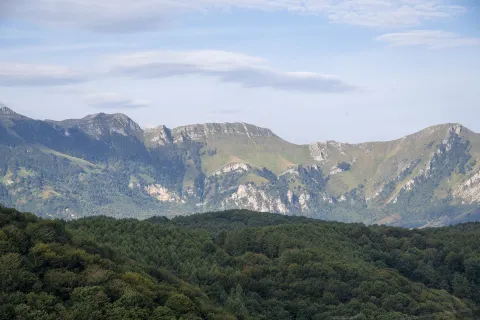
Malloas Cable Observatory
Here, where the air still seems to hold the whisper of descending loads and the limestone ridges of … -
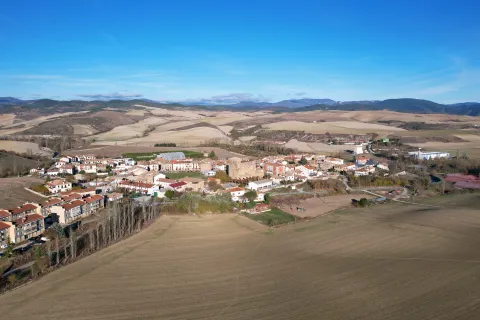
The farmhouses
Here, where stone and wood come together to sustain centuries of quiet life, time settles beneath sl… -
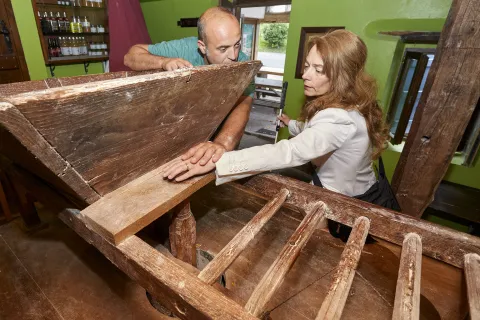
Amaiur Mill
At the entrance to Amaiur , the mill emerges as a discreet yet constant presence, linked to the soun… -
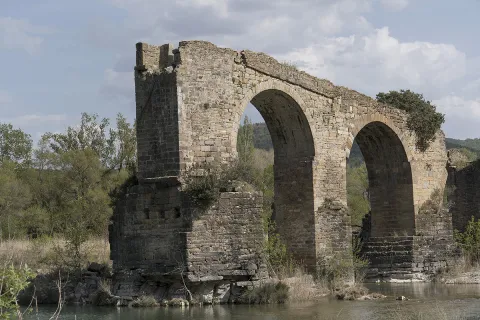
Roncaleses Bridge
Here, where stone bears the memory of passage and the River Aragón flows beneath arches that are no …
