

Aezkoa granaries
Structures suspended between earth and memory
Here, where the granaries rise above the earth as guardians of the grain and stone stands tall to protect the memory of the harvest, time simply passes. The granaries of Aezkoa, supported by sturdy pillars and crowned by the tornarratas, inhabit the landscape as a silent response to the dampness of the Pyrenees and the passing of the seasons. Around them, the life of the valley is reflected in the rhythm of the threshing floors, in the bated anticipation of each agricultural cycle and in the persistence of an architecture born of necessity.
It is a land of contemplation and heritage, where the hórreos not only store food, but also preserve the identity of a way of life in the mountains that still persists today, unhurried.
Aezkoa granaries general information
They are recognised as one of the most unique examples of civil architecture in Navarre, housing 15 of the 22 hórreos preserved in the region, all of which have been declared Assets of Cultural Interest. Their identity is rooted in the historical need of their inhabitants to store grain safe from rodents and the extreme dampness of these Pyrenean landscapes.
Their history dates back to the Middle Ages. They are distinguished by a Pyrenean-style design, characterised by a rectangular floor plan, walls of uncut stone and gabled roofs with very little overhang, traditionally constructed from wooden shingles. Their most distinctive feature is the upright pillars on which they stand, topped by circular slabs known as ‘tornarratas’, whose mineral composition prevents animals from accessing the upper store. Inside, daily life was organised into compartments or ‘zizkus’ to separate wheat, oats, barley and beans.
How to get to the Aezkoa Hórreos?
The route to the hórreos follows the roads that criss-cross the eastern Navarrese Pyrenees, usually starting from Pamplona via the NA-150 towards Aoiz and connecting with the NA-140, which runs through the heart of the valley.
- Main viewing points: The granaries are concentrated particularly in the villages of Aria , Orbaizeta and Hiriberri/Villanueva de Aezkoa .
- Other settlements: Structures are also found in Garaioa, Aribe, Orbara and Garralda, where they blend into the landscape amongst the traditional stone houses.
- Nearby landmark: If travelling from Valle de Arce , we recommend visiting the Romanesque granary at Lusarreta , an unusual example built on stone arches, located just 15 minutes from the area.
What to do at the Aezkoa Granaries?
This region reveals a landscape where architecture and agricultural life beat to the same rhythm.
- Exploring the Granary Route: A space for observation, allowing you to wander leisurely through its villages and discover granaries known by the names of the houses to which they belong, such as Maisterra ( Garaioa) , Reka (Hiriberri) or Jabat (Orbara).
- Observing details and reliefs: Recording ancient inscriptions on façades, such as those on the granary of Casa Reka, or structures that retain their original timber and pillars, such as that of Casa Larrañeta in Orbaizeta .
- Hiking and landscape: A region where mineral heritage blends with the natural environment, exploring easy trails offering views over the Irati Forest or visiting the Ariztokia Viewpoint in Garralda .
- Photography of traditional architecture: Its structures provide a unique setting for capturing the interplay between stone and the Pyrenean landscape, particularly in autumn or under a blanket of snow.
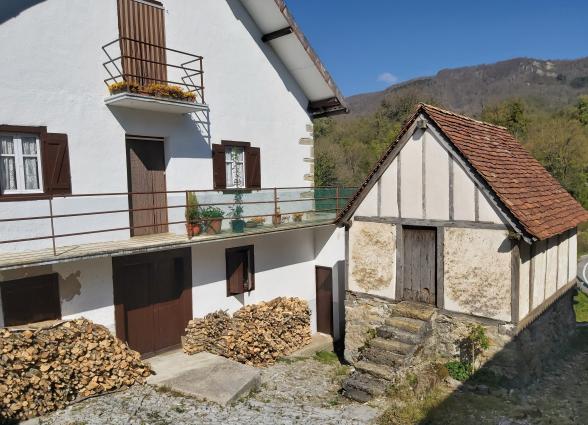
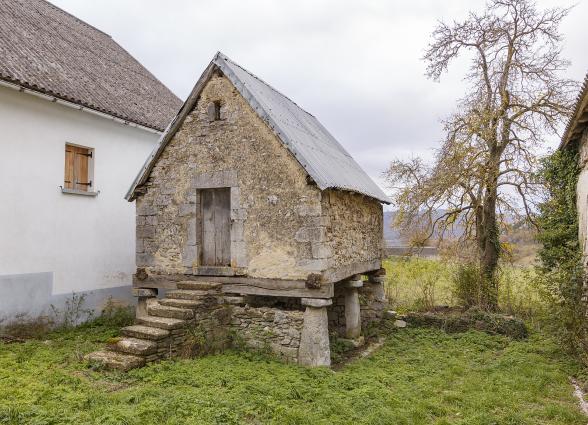
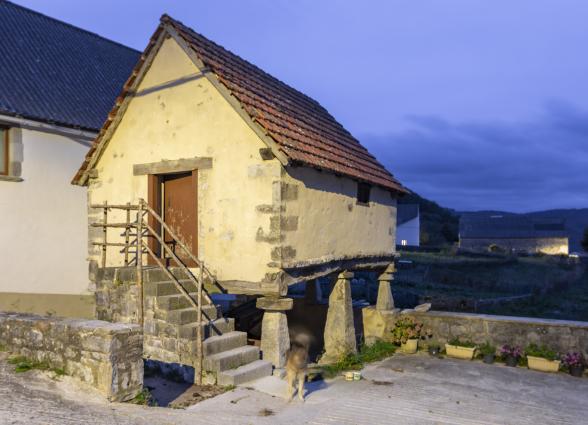
Información sobre: Aezkoa granaries
-
The farmhouses
Here, where stone and wood come together to sustain centuries of quiet life, time settles beneath sl… -
Museum of Funerary Stelae
Here, where stone steles rise like circles facing the sun and the earth holds the names of the homes… -
Amaiur Mill
At the entrance to Amaiur , the mill emerges as a discreet yet constant presence, linked to the soun… -
Donamaria Tower
Here, where the tower rises, its silhouette of stone and wood forming a gateway to Malerreka , time …
